

Robot Controllers Market
Robot Controllers Market (Type: Conventional Controllers and New-Generation (AI/Edge-Enabled) Controllers; Robot Type: Articulated, Collaborative (Cobots), SCARA, Delta, Cartesian, Mobile Robots and Humanoid; Component: Hardware and Software; Deployment: On-Premise and Cloud-Based; and End-Use Industry: Automotive, Electronics & Semiconductor, General Manufacturing, Logistics & Warehousing, Defense and Others) – Global Industry Analysis, Shares, Growth, Trends and Forecast 2021-2036
| Format: PDF/PPT/Excel
| Product ID:
4855
| Report Version:
August 2026
- Report Preview
- Table of Content
- Request Customization
Market Snappshot
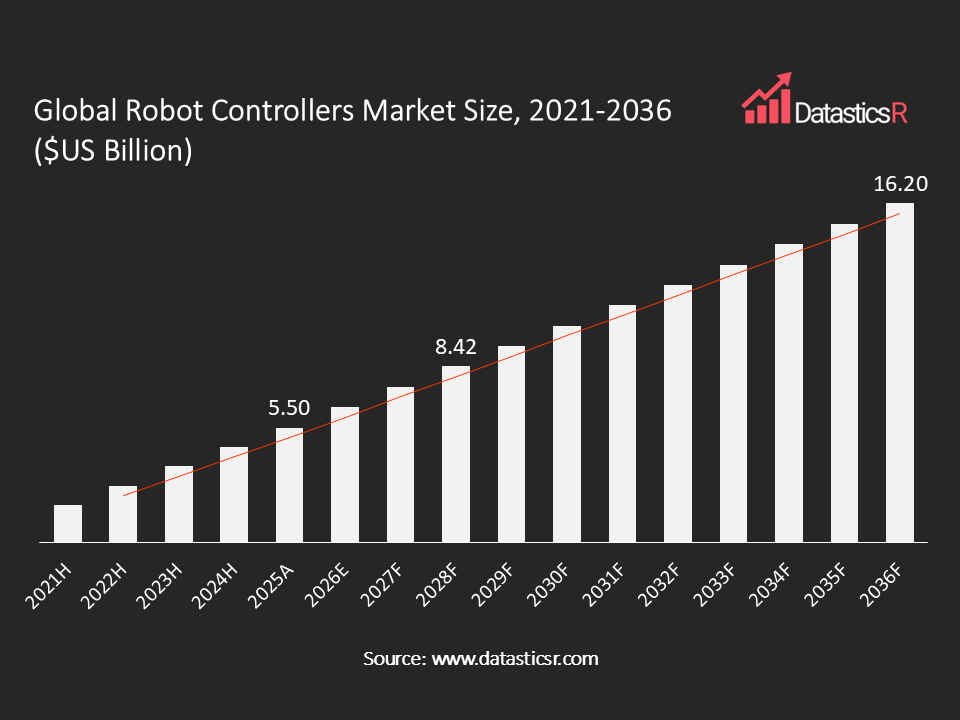
- Market Size in 2025: $US 5.5 Bn
- Forecast Market by 2036: $US 16.2 Bn
- CAGR for the Period 2026-2036: 9.6%
- Top Region in Terms of Market Share: Asia Pacific (40%)
- Key Players: ABB Robotics, FANUC, KUKA AG, Yaskawa Electric Corporation, Universal Robots, Denso Corporation, Kawasaki, Epson Robots, Mitsubishi Electric, Stäubli Robotics and Others
Analyst Viewpoint:
The robot controller has quietly become the most contested piece of real estate in industrial automation. For sixty years it was a fixed-logic box that executed a taught path and little else; today it is being rebuilt, almost simultaneously across every major robot manufacturer, into an AI-capable edge computer that can run perception, adapt to variation, and validate itself against a digital twin before it ever touches a real part. That shift did not happen gradually, it arrived in a compressed 24-month window as NVIDIA’s Omniverse and Isaac ecosystem gave ABB, FANUC, KUKA, and Yaskawa a common software substrate to build on. What makes this moment different from prior automation cycles is that the new-generation controller is being positioned as the answer to a labor problem, not just a productivity one. ABB’s OmniCore, and the wave of Jetson-based edge inference now appearing across FANUC, KUKA, and Yaskawa controllers, are explicitly marketed at manufacturers who cannot hire enough skilled programmers or line workers, promising robots that can be set up and reconfigured with little robotics expertise. That reframing, from ‘faster automation’ to ‘automation that needs fewer specialized humans to run it’, is likely to be the single biggest driver of new-generation controller adoption over the next decade. The open question is how quickly this filters down from flagship platforms and pilot lines, Foxconn’s electronics assembly pilot, BMW and Mercedes’ humanoid trials, into the mid-market. Legacy controllers still run the overwhelming majority of the roughly 4-million-unit global industrial robot install base, and replacement cycles, not net-new installations, will determine how fast new-generation architecture actually displaces them. Vendors that can offer a credible upgrade path for an existing robot fleet, rather than a forced full-line replacement, are best positioned to capture that transition.
Robot Controllers Market Overview:
A robot controller is the hardware-and-software system that executes programmed instructions, coordinates multi-axis motion, integrates sensor and vision data, and enforces safety compliance for an industrial or service robot. Historically built around fixed-logic motion control boards and teach-pendant programming, the market is now bifurcating between legacy/conventional controllers and a new generation of AI-capable, edge-computing-enabled controllers designed to support physical AI, real-time perception, and digital-twin-validated deployment.
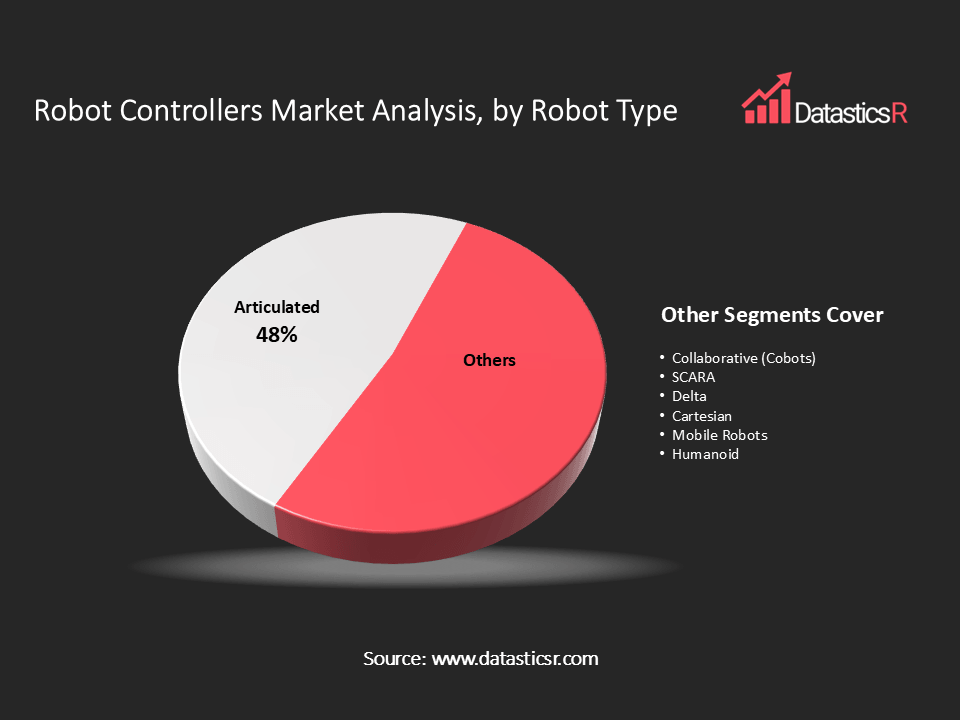
By type, conventional controllers still account for an estimated 61% of 2025 revenue given the sheer size of the installed base, but new-generation AI/edge-enabled controllers, representing an estimated 39% share, are growing at nearly double the overall market rate as manufacturers migrate flagship lines onto AI-ready architecture. By robot type, articulated robot controllers lead with an estimated 48% share, while humanoid & mobile robot controllers, though the smallest category today, are the fastest-growing as humanoid pilots scale from single-digit to low-hundred unit deployments. By component, hardware still leads at an estimated 57% share, but controller software, control algorithms, AI inference stacks, and simulation/digital-twin software increasingly sold as standalone subscriptions, is the fastest-growing component. By deployment, on-premise controllers hold an estimated 64% share, while edge AI-enabled controllers are the fastest-growing architecture. By end-use industry, automotive remains the largest at an estimated 34% share, while electronics & semiconductor and logistics & warehousing are growing fastest, reflecting new consumer-electronics assembly pilots and AMR fleet expansion.
The defining trend reshaping this market is the convergence of robot controllers with AI accelerator hardware and cloud/edge simulation platforms, moving the controller from a closed, single-purpose motion-execution box toward an open, continuously updated compute platform capable of real-time inference, fleet-level orchestration, and pre-deployment validation in a physically accurate digital twin.
By type, conventional controllers still account for an estimated 61% of 2025 revenue given the sheer size of the installed base, but new-generation AI/edge-enabled controllers, representing an estimated 39% share, are growing at nearly double the overall market rate as manufacturers migrate flagship lines onto AI-ready architecture. By robot type, articulated robot controllers lead with an estimated 48% share, while humanoid & mobile robot controllers, though the smallest category today, are the fastest-growing as humanoid pilots scale from single-digit to low-hundred unit deployments. By component, hardware still leads at an estimated 57% share, but controller software, control algorithms, AI inference stacks, and simulation/digital-twin software increasingly sold as standalone subscriptions, is the fastest-growing component. By deployment, on-premise controllers hold an estimated 64% share, while edge AI-enabled controllers are the fastest-growing architecture. By end-use industry, automotive remains the largest at an estimated 34% share, while electronics & semiconductor and logistics & warehousing are growing fastest, reflecting new consumer-electronics assembly pilots and AMR fleet expansion.
The defining trend reshaping this market is the convergence of robot controllers with AI accelerator hardware and cloud/edge simulation platforms, moving the controller from a closed, single-purpose motion-execution box toward an open, continuously updated compute platform capable of real-time inference, fleet-level orchestration, and pre-deployment validation in a physically accurate digital twin.
| Drivers | Accelerating Integration of Physical AI and Edge Computing into Robot Controller Architecture |
| Expanding Global Robot Install Base and Replacement of Legacy Fixed-Logic Controllers |
Accelerating Integration of Physical AI and Edge Computing into Robot Controller Architecture
At NVIDIA’s GTC 2026 conference, the world’s largest industrial robot manufacturers, ABB, FANUC, KUKA, and Yaskawa, collectively representing an installed base of more than two million robots, confirmed they are integrating NVIDIA Jetson edge-AI modules directly into their controllers and validating production lines through NVIDIA Omniverse and Isaac digital-twin simulation. NVIDIA’s own framing, that ‘every industrial company will become a robotics company’, reflects how central AI-capable controller architecture has become to competitive positioning across the sector.
ABB’s OmniCore, launched in 2024 on more than $170 million of R&D investment and set to fully replace the legacy IRC5 platform when it is phased out in June 2026, illustrates the scale of this transition: an entire flagship controller line rebuilt around modular AI, sensor, and cloud/edge integration rather than incremental firmware updates. ABB’s RobotStudio HyperReality, built on NVIDIA Omniverse libraries and launching in the second half of 2026, further extends this architecture into pre-deployment simulation, with early pilots at Foxconn reporting up to 80% reductions in setup and commissioning time.
This driver directly underpins the new-generation controller segment’s outsized growth relative to the legacy segment, and is expected to keep humanoid & mobile robot controllers and edge AI-enabled deployment architecture as the fastest-growing sub-segments through the forecast period.
ABB’s OmniCore, launched in 2024 on more than $170 million of R&D investment and set to fully replace the legacy IRC5 platform when it is phased out in June 2026, illustrates the scale of this transition: an entire flagship controller line rebuilt around modular AI, sensor, and cloud/edge integration rather than incremental firmware updates. ABB’s RobotStudio HyperReality, built on NVIDIA Omniverse libraries and launching in the second half of 2026, further extends this architecture into pre-deployment simulation, with early pilots at Foxconn reporting up to 80% reductions in setup and commissioning time.
This driver directly underpins the new-generation controller segment’s outsized growth relative to the legacy segment, and is expected to keep humanoid & mobile robot controllers and edge AI-enabled deployment architecture as the fastest-growing sub-segments through the forecast period.
Expanding Global Robot Install Base and Replacement of Legacy Fixed-Logic Controllers
The second driver is simple installed-base math: with a combined global install base exceeding two million robots at the four largest manufacturers alone, and roughly four million industrial robots deployed worldwide, even a modest annual replacement or upgrade rate translates into substantial controller-market volume. Labor shortages are compounding this, with vendors including ABB-based WORKR explicitly targeting small and mid-sized manufacturers that have historically been priced out of robotics because they lack in-house programming teams.
Collaborative and humanoid robot pilots are adding a second growth vector on top of conventional replacement demand. Humanoid deployments remain a small fraction of the installed base, but factory pilots at BMW, Mercedes-Benz, Tesla, and GXO Logistics are creating early demand for a new category of mobile, physical-AI-native controllers distinct from fixed-arm industrial controllers, a category NVIDIA, Figure, Agility Robotics, and Skild AI are all building toward alongside the traditional industrial robot majors.
Competitive dynamics are intensifying alongside this growth: Teradyne Robotics’ 2026 IP infringement suit against Elite Robots over cobot software underscores how much value is now concentrated in controller software itself, not just the mechanical robot arm.
Collaborative and humanoid robot pilots are adding a second growth vector on top of conventional replacement demand. Humanoid deployments remain a small fraction of the installed base, but factory pilots at BMW, Mercedes-Benz, Tesla, and GXO Logistics are creating early demand for a new category of mobile, physical-AI-native controllers distinct from fixed-arm industrial controllers, a category NVIDIA, Figure, Agility Robotics, and Skild AI are all building toward alongside the traditional industrial robot majors.
Competitive dynamics are intensifying alongside this growth: Teradyne Robotics’ 2026 IP infringement suit against Elite Robots over cobot software underscores how much value is now concentrated in controller software itself, not just the mechanical robot arm.
Robot Controllers Regional Market Outlook:
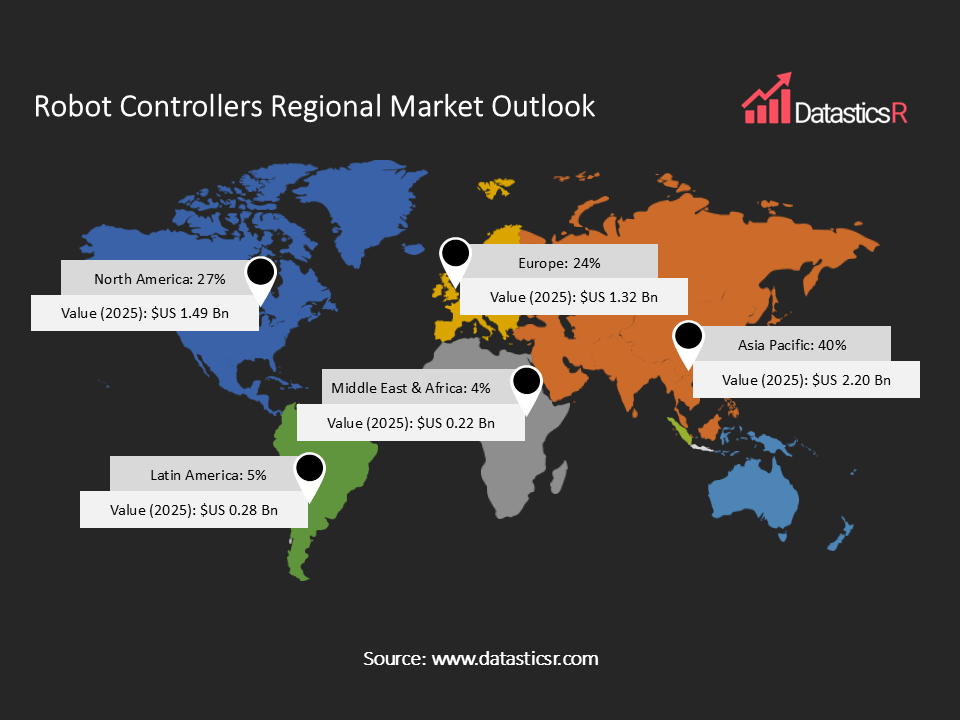
Asia Pacific is the largest market for robot controllers, with an estimated 40% market share, underpinned by China’s dominant share of annual global industrial robot installations and rapidly expanding robot manufacturing capacity across China, Japan, and South Korea.
North America holds an estimated 27% market share and is a leading adopter of new-generation, AI-enabled controller architecture, driven by NVIDIA’s ecosystem leadership, early humanoid factory pilots, and labor-shortage-driven demand from small and mid-sized manufacturers.
Europe accounts for an estimated 24% share, anchored by ABB and KUKA’s home markets and sustained automotive-sector automation investment across Germany, and the wider EU’s continued push toward advanced manufacturing.
Middle East & Africa represents an estimated 4% share and Latin America an estimated 5% share, both reflecting smaller but steadily growing industrial automation bases.
North America holds an estimated 27% market share and is a leading adopter of new-generation, AI-enabled controller architecture, driven by NVIDIA’s ecosystem leadership, early humanoid factory pilots, and labor-shortage-driven demand from small and mid-sized manufacturers.
Europe accounts for an estimated 24% share, anchored by ABB and KUKA’s home markets and sustained automotive-sector automation investment across Germany, and the wider EU’s continued push toward advanced manufacturing.
Middle East & Africa represents an estimated 4% share and Latin America an estimated 5% share, both reflecting smaller but steadily growing industrial automation bases.
Key Companies in Robot Controllers Market:
The competitive field is dominated by the same four manufacturers that lead the global industrial robot market itself, ABB Robotics, FANUC Corporation, KUKA AG, and Yaskawa Electric Corporation, each now racing to migrate its flagship controller platform onto AI-capable, edge-computing architecture. Universal Robots (Teradyne), Denso, Kawasaki Heavy Industries, Epson Robots, Mitsubishi Electric, Omron, Comau, Nachi-Fujikoshi, and Stäubli Robotics round out the broader competitive field across collaborative and specialized robot segments. NVIDIA has emerged as the de facto shared technology enabler across nearly every major controller manufacturer’s new-generation roadmap, supplying the Jetson edge-AI hardware and Omniverse/Isaac simulation software that underpins the current wave of controller modernization, alongside a growing layer of third-party AI control-software providers such as WORKR.
Key Developments in Robot Controllers Market:
| 1. NVIDIA GTC 2026: ABB, FANUC, KUKA, and Yaskawa Integrate Jetson Edge AI and Omniverse/Isaac into Robot Controllers: In March 2026, at NVIDIA’s GTC conference, the world’s four largest industrial robot manufacturers, with a combined installed base exceeding two million robots, confirmed integration of NVIDIA Jetson edge-AI modules into their controllers and adoption of Omniverse and Isaac simulation frameworks to validate production lines through physically accurate digital twins. |
| 2. ABB Robotics and NVIDIA Launch RobotStudio HyperReality on the OmniCore Platform: In March 2026, ABB Robotics announced RobotStudio HyperReality, integrating NVIDIA Omniverse libraries into its RobotStudio software and evaluating NVIDIA Jetson integration into its OmniCore controller, targeting up to 40% lower deployment costs and 50% faster time-to-market, with Foxconn piloting the technology for consumer electronics assembly ahead of a second-half 2026 commercial launch. |
Robot Controllers Market Attributes:
| Market Value, 2025 | $US 5.5 Billion |
| Forecasted Market Value, 2036 | $US 16.2 Billion |
| CAGR (2026-2036) | 9.6% |
| Analysis Period | 2021-2036 |
| Historic Period | 2021-2024 |
| Base Year | 2025 |
| Forecast Period | 2026-2036 |
| Volume Unit | Units |
| Value Unit | $US Billion |
| Market Segmentation | By Type
By Robot Type
By Component
By Deployment
By End-Use Industry
By Region
|
| Companies Profiles |
|
| Customization Request | Available upon request |
1.1. Report Scope
1.2. Market Segmentations and Definitions
1.3. Geographical Coverage
2. Executive Summary
2.1. Key Facts and Figures
2.2. Trends Impacting the Market
2.3. DatasticsR Growth Opportunity Matrix
3. Market Overview
3.1. Global Robot Controllers Market Analysis and Forecast, 2021-2036
3.1.1. Global Robot Controllers Market Size (Units)
3.1.2. Global Robot Controllers Market Size ($US Bn)
3.2. Key Market Trends
3.3. Technology Roadmap and Developments
3.4. Market Dynamics
3.4.1. Drivers
3.4.2. Restraints
3.4.3. Opportunities
3.5. Porter’s Five Forces Analysis
3.6. PESTL Analysis
3.7. Industry SWOT Analysis
3.8. Regulatory Landscape
3.9. Value Chain Analysis
3.9.1. List of Materials Suppliers
3.9.2. List of Manufacturers
3.9.3. List of Dealers / Distributors
3.9.4. List of Potential Customers
3.10. Impact of Current Geopolitical Scenario on the Market
4. Technical Analysis
4.1. Product Specifications Analysis
4.2. Technology Adoption and Emerging Technologies
4.3. R&D Trends and Patents Landscape
4.4. Cost Structure and Profitability Analysis
5. Global Production Output Analysis (Units), by Region, 2025
5.1. North America
5.2. Europe
5.3. Asia Pacific
5.4. Latin America
5.5. Middle East and Africa
6. Import-export Analysis Volume (Units) and Value ($US Bn), by Key Country, 2021-2025
7. Price Trend Analysis and Forecasting ($US/Unit), 2021-2036
7.1. Price Trend Analysis and Forecasting, by Type
7.2. Price Trend Analysis and Forecasting, by Robot Type
7.3. Price Trend Analysis and Forecasting, by Region
8. Global Robot Controllers Market Analysis and Forecasting (Units) ($US Bn), By Type, 2021-2036
9. Global Robot Controllers Market Analysis and Forecasting (Units) ($US Bn), by Robot Type, 2021-2036
10. Global Robot Controllers Market Analysis and Forecasting (Units) ($US Bn), by Deployment, 2021-2036
11. Global Robot Controllers Market Analysis and Forecasting (Units) ($US Bn), by End-use Industry, 2021-2036
12. Global Robot Controllers Market Analysis and Forecasting (Units) ($US Bn), by Region, 2021-2036
13. North America Robot Controllers Market Analysis and Forecasting (Units) ($US Bn), By Type, 2021-2036
14. North America Robot Controllers Market Analysis and Forecasting (Units) ($US Bn), by Robot Type, 2021-2036
15. North America Robot Controllers Market Analysis and Forecasting (Units) ($US Bn), by Deployment, 2021-2036
16. North America Robot Controllers Market Analysis and Forecasting (Units) ($US Bn), by End-use Industry, 2021-2036
17. U.S. Robot Controllers Market Analysis and Forecasting (Units) ($US Bn), By Type, 2021-2036
18. U.S. Robot Controllers Market Analysis and Forecasting (Units) ($US Bn), by Robot Type, 2021-2036
19. U.S. Robot Controllers Market Analysis and Forecasting (Units) ($US Bn), by Deployment, 2021-2036
20. U.S. Robot Controllers Market Analysis and Forecasting (Units) ($US Bn), by End-use Industry, 2021-2036
21. Canada Robot Controllers Market Analysis and Forecasting (Units) ($US Bn), By Type, 2021-2036
22. Canada Robot Controllers Market Analysis and Forecasting (Units) ($US Bn), by Robot Type, 2021-2036
23. Canada Robot Controllers Market Analysis and Forecasting (Units) ($US Bn), by Deployment, 2021-2036
24. Canada Robot Controllers Market Analysis and Forecasting (Units) ($US Bn), by End-use Industry, 2021-2036
25. Europe Robot Controllers Market Analysis and Forecasting (Units) ($US Bn), By Type, 2021-2036
26. Europe Robot Controllers Market Analysis and Forecasting (Units) ($US Bn), by Robot Type, 2021-2036
27. Europe Robot Controllers Market Analysis and Forecasting (Units) ($US Bn), by Deployment, 2021-2036
28. Europe Robot Controllers Market Analysis and Forecasting (Units) ($US Bn), by End-use Industry, 2021-2036
29. Germany Robot Controllers Market Analysis and Forecasting (Units) ($US Bn), By Type, 2021-2036
30. Germany Robot Controllers Market Analysis and Forecasting (Units) ($US Bn), by Robot Type, 2021-2036
31. Germany Robot Controllers Market Analysis and Forecasting (Units) ($US Bn), by Deployment, 2021-2036
32. Germany Robot Controllers Market Analysis and Forecasting (Units) ($US Bn), by End-use Industry, 2021-2036
33. U.K. Robot Controllers Market Analysis and Forecasting (Units) ($US Bn), By Type, 2021-2036
34. U.K. Robot Controllers Market Analysis and Forecasting (Units) ($US Bn), by Robot Type, 2021-2036
35. U.K. Robot Controllers Market Analysis and Forecasting (Units) ($US Bn), by Deployment, 2021-2036
36. U.K. Robot Controllers Market Analysis and Forecasting (Units) ($US Bn), by End-use Industry, 2021-2036
37. France Robot Controllers Market Analysis and Forecasting (Units) ($US Bn), By Type, 2021-2036
38. France Robot Controllers Market Analysis and Forecasting (Units) ($US Bn), by Robot Type, 2021-2036
39. France Robot Controllers Market Analysis and Forecasting (Units) ($US Bn), by Deployment, 2021-2036
40. France Robot Controllers Market Analysis and Forecasting (Units) ($US Bn), by End-use Industry, 2021-2036
41. Italy Robot Controllers Market Analysis and Forecasting (Units) ($US Bn), By Type, 2021-2036
42. Italy Robot Controllers Market Analysis and Forecasting (Units) ($US Bn), by Robot Type, 2021-2036
43. Italy Robot Controllers Market Analysis and Forecasting (Units) ($US Bn), by Deployment, 2021-2036
44. Italy Robot Controllers Market Analysis and Forecasting (Units) ($US Bn), by End-use Industry, 2021-2036
45. Spain Robot Controllers Market Analysis and Forecasting (Units) ($US Bn), By Type, 2021-2036
46. Spain Robot Controllers Market Analysis and Forecasting (Units) ($US Bn), by Robot Type, 2021-2036
47. Spain Robot Controllers Market Analysis and Forecasting (Units) ($US Bn), by Deployment, 2021-2036
48. Spain Robot Controllers Market Analysis and Forecasting (Units) ($US Bn), by End-use Industry, 2021-2036
49. Russia & CIS Robot Controllers Market Analysis and Forecasting (Units) ($US Bn), By Type, 2021-2036
50. Russia & CIS Robot Controllers Market Analysis and Forecasting (Units) ($US Bn), by Robot Type, 2021-2036
51. Russia & CIS Robot Controllers Market Analysis and Forecasting (Units) ($US Bn), by Deployment, 2021-2036
52. Russia & CIS Robot Controllers Market Analysis and Forecasting (Units) ($US Bn), by End-use Industry, 2021-2036
53. Rest of Europe Robot Controllers Market Analysis and Forecasting (Units) ($US Bn), By Type, 2021-2036
54. Rest of Europe Robot Controllers Market Analysis and Forecasting (Units) ($US Bn), by Robot Type, 2021-2036
55. Rest of Europe Robot Controllers Market Analysis and Forecasting (Units) ($US Bn), by Deployment, 2021-2036
56. Rest of Europe Robot Controllers Market Analysis and Forecasting (Units) ($US Bn), by End-use Industry, 2021-2036
57. Asia Pacific Robot Controllers Market Analysis and Forecasting (Units) ($US Bn), By Type, 2021-2036
58. Asia Pacific Robot Controllers Market Analysis and Forecasting (Units) ($US Bn), by Robot Type, 2021-2036
59. Asia Pacific Robot Controllers Market Analysis and Forecasting (Units) ($US Bn), by Deployment, 2021-2036
60. Asia Pacific Robot Controllers Market Analysis and Forecasting (Units) ($US Bn), by End-use Industry, 2021-2036
61. China Robot Controllers Market Analysis and Forecasting (Units) ($US Bn), By Type, 2021-2036
62. China Robot Controllers Market Analysis and Forecasting (Units) ($US Bn), by Robot Type, 2021-2036
63. China Robot Controllers Market Analysis and Forecasting (Units) ($US Bn), by Deployment, 2021-2036
64. China Robot Controllers Market Analysis and Forecasting (Units) ($US Bn), by End-use Industry, 2021-2036
65. India Robot Controllers Market Analysis and Forecasting (Units) ($US Bn), By Type, 2021-2036
66. India Robot Controllers Market Analysis and Forecasting (Units) ($US Bn), by Robot Type, 2021-2036
67. India Robot Controllers Market Analysis and Forecasting (Units) ($US Bn), by Deployment, 2021-2036
68. India Robot Controllers Market Analysis and Forecasting (Units) ($US Bn), by End-use Industry, 2021-2036
69. Japan Robot Controllers Market Analysis and Forecasting (Units) ($US Bn), By Type, 2021-2036
70. Japan Robot Controllers Market Analysis and Forecasting (Units) ($US Bn), by Robot Type, 2021-2036
71. Japan Robot Controllers Market Analysis and Forecasting (Units) ($US Bn), by Deployment, 2021-2036
72. Japan Robot Controllers Market Analysis and Forecasting (Units) ($US Bn), by End-use Industry, 2021-2036
73. South Korea Robot Controllers Market Analysis and Forecasting (Units) ($US Bn), By Type, 2021-2036
74. South Korea Robot Controllers Market Analysis and Forecasting (Units) ($US Bn), by Robot Type, 2021-2036
75. South Korea Robot Controllers Market Analysis and Forecasting (Units) ($US Bn), by Deployment, 2021-2036
76. South Korea Robot Controllers Market Analysis and Forecasting (Units) ($US Bn), by End-use Industry, 2021-2036
77. Taiwan Robot Controllers Market Analysis and Forecasting (Units) ($US Bn), By Type, 2021-2036
78. Taiwan Robot Controllers Market Analysis and Forecasting (Units) ($US Bn), by Robot Type, 2021-2036
79. Taiwan Robot Controllers Market Analysis and Forecasting (Units) ($US Bn), by Deployment, 2021-2036
80. Taiwan Robot Controllers Market Analysis and Forecasting (Units) ($US Bn), by End-use Industry, 2021-2036
81. Australia Robot Controllers Market Analysis and Forecasting (Units) ($US Bn), By Type, 2021-2036
82. Australia Robot Controllers Market Analysis and Forecasting (Units) ($US Bn), by Robot Type, 2021-2036
83. Australia Robot Controllers Market Analysis and Forecasting (Units) ($US Bn), by Deployment, 2021-2036
84. Australia Robot Controllers Market Analysis and Forecasting (Units) ($US Bn), by End-use Industry, 2021-2036
85. ASEAN Robot Controllers Market Analysis and Forecasting (Units) ($US Bn), By Type, 2021-2036
86. ASEAN Robot Controllers Market Analysis and Forecasting (Units) ($US Bn), by Robot Type, 2021-2036
87. ASEAN Robot Controllers Market Analysis and Forecasting (Units) ($US Bn), by Deployment, 2021-2036
88. ASEAN Robot Controllers Market Analysis and Forecasting (Units) ($US Bn), by End-use Industry, 2021-2036
89. Rest of Asia Pacific Robot Controllers Market Analysis and Forecasting (Units) ($US Bn), By Type, 2021-2036
90. Rest of Asia Pacific Robot Controllers Market Analysis and Forecasting (Units) ($US Bn), by Robot Type, 2021-2036
91. Rest of Asia Pacific Robot Controllers Market Analysis and Forecasting (Units) ($US Bn), by Deployment, 2021-2036
92. Rest of Asia Pacific Robot Controllers Market Analysis and Forecasting (Units) ($US Bn), by End-use Industry, 2021-2036
93. Latin America Robot Controllers Market Analysis and Forecasting (Units) ($US Bn), By Type, 2021-2036
94. Latin America Robot Controllers Market Analysis and Forecasting (Units) ($US Bn), by Robot Type, 2021-2036
95. Latin America Robot Controllers Market Analysis and Forecasting (Units) ($US Bn), by Deployment, 2021-2036
96. Latin America Robot Controllers Market Analysis and Forecasting (Units) ($US Bn), by End-use Industry, 2021-2036
97. Brazil Robot Controllers Market Analysis and Forecasting (Units) ($US Bn), By Type, 2021-2036
98. Brazil Robot Controllers Market Analysis and Forecasting (Units) ($US Bn), by Robot Type, 2021-2036
99. Brazil Robot Controllers Market Analysis and Forecasting (Units) ($US Bn), by Deployment, 2021-2036
100. Brazil Robot Controllers Market Analysis and Forecasting (Units) ($US Bn), by End-use Industry, 2021-2036
101. Mexico Robot Controllers Market Analysis and Forecasting (Units) ($US Bn), By Type, 2021-2036
102. Mexico Robot Controllers Market Analysis and Forecasting (Units) ($US Bn), by Robot Type, 2021-2036
103. Mexico Robot Controllers Market Analysis and Forecasting (Units) ($US Bn), by Deployment, 2021-2036
104. Mexico Robot Controllers Market Analysis and Forecasting (Units) ($US Bn), by End-use Industry, 2021-2036
105. Argentina Robot Controllers Market Analysis and Forecasting (Units) ($US Bn), By Type, 2021-2036
106. Argentina Robot Controllers Market Analysis and Forecasting (Units) ($US Bn), by Robot Type, 2021-2036
107. Argentina Robot Controllers Market Analysis and Forecasting (Units) ($US Bn), by Deployment, 2021-2036
108. Argentina Robot Controllers Market Analysis and Forecasting (Units) ($US Bn), by End-use Industry, 2021-2036
109. Rest of Latin America Robot Controllers Market Analysis and Forecasting (Units) ($US Bn), By Type, 2021-2036
110. Rest of Latin America Robot Controllers Market Analysis and Forecasting (Units) ($US Bn), by Robot Type, 2021-2036
111. Rest of Latin America Robot Controllers Market Analysis and Forecasting (Units) ($US Bn), by Deployment, 2021-2036
112. Rest of Latin America Robot Controllers Market Analysis and Forecasting (Units) ($US Bn), by End-use Industry, 2021-2036
113. Middle East & Africa Robot Controllers Market Analysis and Forecasting (Units) ($US Bn), By Type, 2021-2036
114. Middle East & Africa Robot Controllers Market Analysis and Forecasting (Units) ($US Bn), by Robot Type, 2021-2036
115. Middle East & Africa Robot Controllers Market Analysis and Forecasting (Units) ($US Bn), by Deployment, 2021-2036
116. Middle East & Africa Robot Controllers Market Analysis and Forecasting (Units) ($US Bn), by End-use Industry, 2021-2036
117. Saudi Arabia Robot Controllers Market Analysis and Forecasting (Units) ($US Bn), By Type, 2021-2036
118. Saudi Arabia Robot Controllers Market Analysis and Forecasting (Units) ($US Bn), by Robot Type, 2021-2036
119. Saudi Arabia Robot Controllers Market Analysis and Forecasting (Units) ($US Bn), by Deployment, 2021-2036
120. Saudi Arabia Robot Controllers Market Analysis and Forecasting (Units) ($US Bn), by End-use Industry, 2021-2036
121. UAE Robot Controllers Market Analysis and Forecasting (Units) ($US Bn), By Type, 2021-2036
122. UAE Robot Controllers Market Analysis and Forecasting (Units) ($US Bn), by Robot Type, 2021-2036
123. UAE Robot Controllers Market Analysis and Forecasting (Units) ($US Bn), by Deployment, 2021-2036
124. UAE Robot Controllers Market Analysis and Forecasting (Units) ($US Bn), by End-use Industry, 2021-2036
125. South Africa Robot Controllers Market Analysis and Forecasting (Units) ($US Bn), By Type, 2021-2036
126. South Africa Robot Controllers Market Analysis and Forecasting (Units) ($US Bn), by Robot Type, 2021-2036
127. South Africa Robot Controllers Market Analysis and Forecasting (Units) ($US Bn), by Deployment, 2021-2036
128. South Africa Robot Controllers Market Analysis and Forecasting (Units) ($US Bn), by End-use Industry, 2021-2036
129. Rest of Middle East & Africa Robot Controllers Market Analysis and Forecasting (Units) ($US Bn), By Type, 2021-2036
130. Rest of Middle East & Africa Robot Controllers Market Analysis and Forecasting (Units) ($US Bn), by Robot Type, 2021-2036
131. Rest of Middle East & Africa Robot Controllers Market Analysis and Forecasting (Units) ($US Bn), by Deployment, 2021-2036
132. Rest of Middle East & Africa Robot Controllers Market Analysis and Forecasting (Units) ($US Bn), by End-use Industry, 2021-2036
133. Competition Landscape
133.1. Market Share Analysis (%), by Company, 2025
133.2. Competitive Benchmarking
133.3. Company Profiles
133.3.1. ABB Robotics
133.3.1.1. Company Overview
133.3.1.2. Business Portfolio
133.3.1.3. Financials
133.3.1.4. Geographical Footprint
133.3.1.5. SWOT Analysis
133.3.1.6. Recent Developments and Strategies
133.3.2. FANUC
133.3.2.1. Company Overview
133.3.2.2. Business Portfolio
133.3.2.3. Financials
133.3.2.4. Geographical Footprint
133.3.2.5. SWOT Analysis
133.3.2.6. Recent Developments and Strategies
133.3.3. KUKA AG
133.3.3.1. Company Overview
133.3.3.2. Business Portfolio
133.3.3.3. Financials
133.3.3.4. Geographical Footprint
133.3.3.5. SWOT Analysis
133.3.3.6. Recent Developments and Strategies
133.3.4. Yaskawa Electric Corporation
133.3.4.1. Company Overview
133.3.4.2. Business Portfolio
133.3.4.3. Financials
133.3.4.4. Geographical Footprint
133.3.4.5. SWOT Analysis
133.3.4.6. Recent Developments and Strategies
133.3.5. Universal Robots
133.3.5.1. Company Overview
133.3.5.2. Business Portfolio
133.3.5.3. Financials
133.3.5.4. Geographical Footprint
133.3.5.5. SWOT Analysis
133.3.5.6. Recent Developments and Strategies
133.3.6. Denso Corporation
133.3.6.1. Company Overview
133.3.6.2. Business Portfolio
133.3.6.3. Financials
133.3.6.4. Geographical Footprint
133.3.6.5. SWOT Analysis
133.3.6.6. Recent Developments and Strategies
133.3.7. Kawasaki
133.3.7.1. Company Overview
133.3.7.2. Business Portfolio
133.3.7.3. Financials
133.3.7.4. Geographical Footprint
133.3.7.5. SWOT Analysis
133.3.7.6. Recent Developments and Strategies
133.3.8. Epson Robots
133.3.8.1. Company Overview
133.3.8.2. Business Portfolio
133.3.8.3. Financials
133.3.8.4. Geographical Footprint
133.3.8.5. SWOT Analysis
133.3.8.6. Recent Developments and Strategies
133.3.9. Mitsubishi Electric
133.3.9.1. Company Overview
133.3.9.2. Business Portfolio
133.3.9.3. Financials
133.3.9.4. Geographical Footprint
133.3.9.5. SWOT Analysis
133.3.9.6. Recent Developments and Strategies
133.3.10. Stäubli Robotics
133.3.10.1. Company Overview
133.3.10.2. Business Portfolio
133.3.10.3. Financials
133.3.10.4. Geographical Footprint
133.3.10.5. SWOT Analysis
133.3.10.6. Recent Developments and Strategies
133.3.11. Others
134. Appendix

- Get Started -
Get insights that lead to new growth opportunities
- Talk to Experts -
Get answers to your queries on this report from our experts
Frequently Asked Questions
The global Robot Controllers market in 2025 was $US 5.5 Billion.
The global Robot Controllers market will be $US 16.2 Billion by 2036.
The expected growth rate (CAGR%) of the global Robot Controllers market is 9.6% for the period 2026-2036.
Accelerating Integration of Physical AI and Edge Computing into Robot Controller Architecture and Expanding Global Robot Install Base and Replacement of Legacy Fixed-Logic Controllers.
Conventional Controllers was the largest segment in type with around 61% revenue share among all in Robot Controllers Market in 2025.
Asia Pacific was the leading regions for Robot Controllers holding 40% of the global market in 2025.
ABB Robotics, FANUC, KUKA AG, Yaskawa Electric Corporation, Universal Robots, Denso Corporation, Kawasaki, Epson Robots, Mitsubishi Electric, Stäubli Robotics and Others.