

Drone Components Market
Drone Components Market (Component: Airframe & Structural Components, Sensors/Cameras & Payload Systems, Propulsion Systems, Batteries & Power Systems, Flight Controllers & Navigation Systems, Communication & Data-Link Systems, and Others; Platform: Rotary-Wing, Fixed-Wing, Hybrid VTOL and Others; and End-Use: Defense & Military, Precision Agriculture, Infrastructure & Energy Inspection, Construction & Mining, Logistics & Last-Mile Delivery, Public Safety & Emergency Response, Mapping/Surveying/GIS, and Others) – Global Industry Analysis, Shares, Growth, Trends and Forecast 2021-2036
| Format: PDF/PPT/Excel
| Product ID:
4865
| Report Version:
August 2026
- Report Preview
- Table of Content
- Request Customization
Market Snappshot
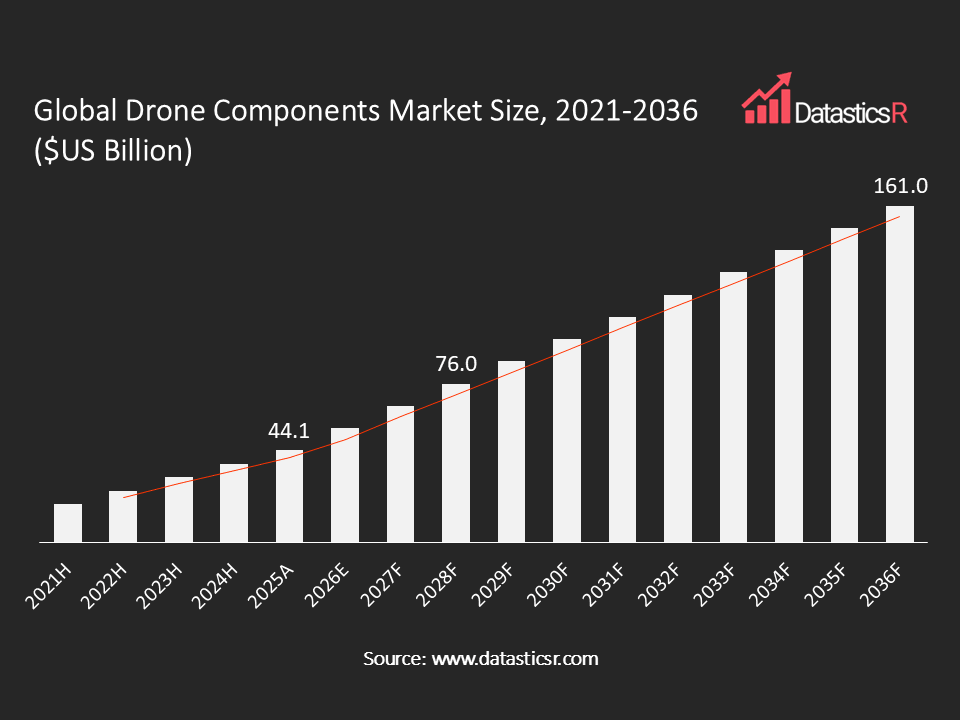
- Market Size in 2025: $US 44.1 Bn
- Forecast Market by 2036: $US 161 Bn
- CAGR for the Period 2026-2036: 11.4%
- Top Region in Terms of Market Share: North America (42%)
- Key Players: DJI-Innovations, T-Motor (Tmotor), Ambarella Inc., Teledyne FLIR, Auterion AG, u-blox, Unusual Machines Corporation, ePropelled, Vertiq, KULR Technology Group and Others
Analyst Viewpoint:
Few component markets have had their competitive map redrawn as abruptly as this one. For a decade, the drone component supply chain was quietly dominated by a handful of Chinese suppliers, batteries, motors, magnets, flight controllers, cameras, sourced at a cost structure Western manufacturers could not match. Regulatory action taken between December 2025 and mid-2026, the FCC’s Covered List expansion, DJI’s placement on it, and the Pentagon’s phased Drone Dominance sourcing framework, has now forced that supply chain to be rebuilt onshore in real time, and Western component makers openly admit the domestic alternative still costs two to five times more. The other story reshaping this market is scale, not sophistication. Ukraine’s defense-industrial base now has the capacity to build more than eight million FPV strike drones a year, at unit costs as low as $300 to $500, using largely commodity motors, batteries, and cameras rather than exotic components. That volume, replicated in various forms across other militaries now building low-cost loitering munition programs, is turning what was once a niche defense category into one of the largest single demand pools for basic drone components anywhere in the market. On the civil side, growth is steadier and more diversified: agriculture, infrastructure inspection, and logistics are each scaling briskly without any single dramatic catalyst, and hybrid VTOL platforms are pulling component demand toward longer-endurance propulsion and battery systems. The component suppliers best positioned across both worlds are the ones that can certify a single product line, a motor, a battery pack, a flight controller, against both NDAA/Blue UAS defense standards and civil aviation requirements simultaneously, rather than building separate defense and commercial product lines from scratch.
Drone Components Market Overview:
Drone components comprise the airframes, propulsion systems, batteries, sensors and cameras, flight controllers and navigation systems, communication and data-link systems, and software/autonomy stacks that together constitute an unmanned aerial system, sold both as OEM inputs to drone manufacturers and as certified replacement or upgrade parts to operators.
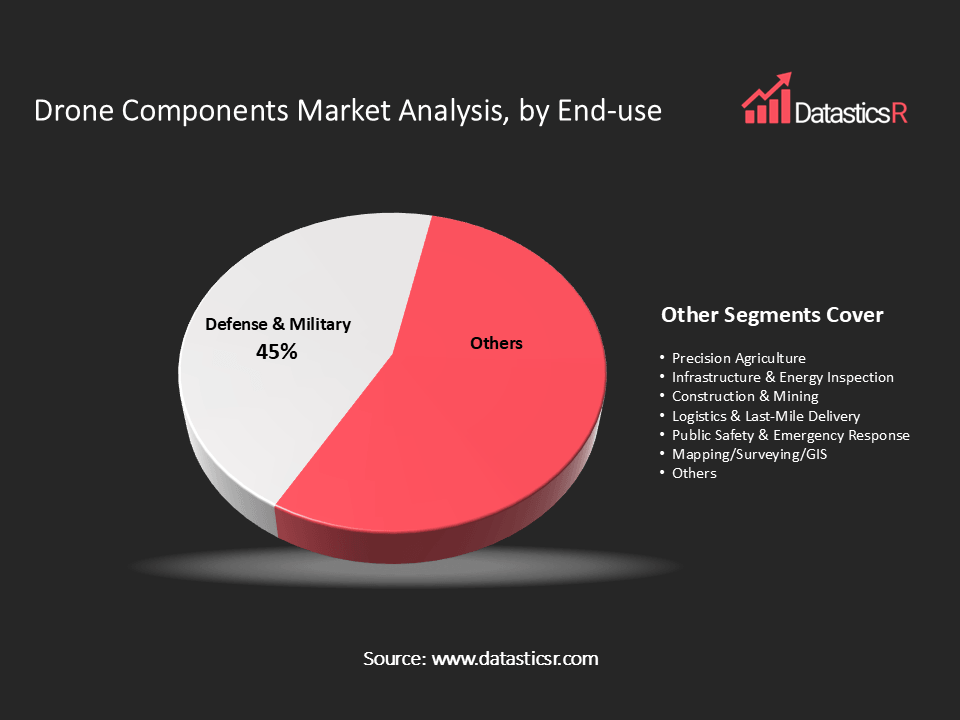
By component, airframe & structural components lead with an estimated 22% share, followed by sensors, cameras & payload systems, propulsion systems, and batteries & power systems; software & AI/autonomy systems hold the smallest share today but are the fastest-growing component category by a wide margin as autonomous navigation, computer-vision payload processing, and swarm coordination software increasingly differentiate platforms. By platform, rotary-wing/multirotor designs account for an estimated 58% share given their dominance in both commercial inspection and FPV strike-drone applications, while hybrid VTOL platforms are the fastest-growing platform category as long-endurance logistics and ISR missions scale. By end-use, defense & military applications represent the single largest category at an estimated 45% share, driven by loitering munition and FPV strike-drone mass production, while commercial/civil applications led by precision agriculture and infrastructure inspection.
The defining trend reshaping this market is the bifurcation of the supply base along national-security lines: components are increasingly being designed, qualified, and marketed specifically as NDAA/Blue UAS-compliant or non-compliant, a distinction now more commercially consequential for many suppliers than the traditional distinction between commercial-grade and defense-grade hardware.
By component, airframe & structural components lead with an estimated 22% share, followed by sensors, cameras & payload systems, propulsion systems, and batteries & power systems; software & AI/autonomy systems hold the smallest share today but are the fastest-growing component category by a wide margin as autonomous navigation, computer-vision payload processing, and swarm coordination software increasingly differentiate platforms. By platform, rotary-wing/multirotor designs account for an estimated 58% share given their dominance in both commercial inspection and FPV strike-drone applications, while hybrid VTOL platforms are the fastest-growing platform category as long-endurance logistics and ISR missions scale. By end-use, defense & military applications represent the single largest category at an estimated 45% share, driven by loitering munition and FPV strike-drone mass production, while commercial/civil applications led by precision agriculture and infrastructure inspection.
The defining trend reshaping this market is the bifurcation of the supply base along national-security lines: components are increasingly being designed, qualified, and marketed specifically as NDAA/Blue UAS-compliant or non-compliant, a distinction now more commercially consequential for many suppliers than the traditional distinction between commercial-grade and defense-grade hardware.
| Drivers | Defense Reshoring and NDAA/FCC-Driven Domestic Component Sourcing Mandates |
| Mass-Scale Loitering Munition and FPV Strike-Drone Production Driving Commodity Component Demand |
Defense Reshoring and NDAA/FCC-Driven Domestic Component Sourcing Mandates
U.S. policy has moved decisively to restrict foreign-made drone components since late 2025. The FCC’s December 2025 Covered List action barred new equipment authorizations for foreign-made drones and critical components, including motors, batteries, flight controllers, navigation systems, cameras, and data-transmission devices, with only temporary exemptions for Blue UAS-cleared and domestic-end-product components running through January 1, 2027. DJI’s placement on the Covered List has frozen roughly 25 planned 2026 U.S. product launches worth an estimated $1.5 billion in revenue, while the FY2026 NDAA layered additional restrictions on batteries and rare-earth-dependent motor components from foreign entities of concern.
This has triggered a wave of domestic component investment: ePropelled is expanding New Hampshire production toward hundreds of thousands of motors and controllers annually, Unusual Machines was producing roughly 15,000 motors per month in Orlando as of April 2026 and adding automation to scale further, and Vertiq’s motor-and-ESC module became the first such combination added to the Defense Innovation Unit’s Blue UAS Framework. On batteries, KULR Technology Group and Texas-based Hylio announced a February 2026 partnership to manufacture NDAA-compliant battery systems domestically, while CRG Defense has positioned its U.S.-made battery cells, packs, and propulsion systems directly against the sourcing gap.
Because China still controls the dominant share of global rare-earth magnet processing and an estimated 99% of the specific battery chemistries used in many drones, this reshoring push is expected to keep component costs elevated, Western alternatives currently run two to five times the cost of Chinese equivalents, while simultaneously expanding the addressable market for domestic component manufacturers well beyond what natural commercial demand alone would generate.
This has triggered a wave of domestic component investment: ePropelled is expanding New Hampshire production toward hundreds of thousands of motors and controllers annually, Unusual Machines was producing roughly 15,000 motors per month in Orlando as of April 2026 and adding automation to scale further, and Vertiq’s motor-and-ESC module became the first such combination added to the Defense Innovation Unit’s Blue UAS Framework. On batteries, KULR Technology Group and Texas-based Hylio announced a February 2026 partnership to manufacture NDAA-compliant battery systems domestically, while CRG Defense has positioned its U.S.-made battery cells, packs, and propulsion systems directly against the sourcing gap.
Because China still controls the dominant share of global rare-earth magnet processing and an estimated 99% of the specific battery chemistries used in many drones, this reshoring push is expected to keep component costs elevated, Western alternatives currently run two to five times the cost of Chinese equivalents, while simultaneously expanding the addressable market for domestic component manufacturers well beyond what natural commercial demand alone would generate.
Mass-Scale Loitering Munition and FPV Strike-Drone Production Driving Commodity Component Demand
The war in Ukraine has demonstrated that low-cost, mass-produced FPV strike drones and loitering munitions can be built at unit costs of $300 to $500 using largely commodity motors, batteries, cameras, and flight controllers, and Ukraine’s defense-industrial base, now more than 500 manufacturers strong compared with roughly seven before 2022, has scaled installed FPV production capacity to an estimated 8 to 10 million units annually, with actual 2026 output planned around 4.5 million units.
This production model is being replicated elsewhere: European loitering-munition developers such as Lithuania’s RSI Europe and Granta Autonomy, and Ukrainian producers including Fire Point, UkrSpecSystems, and Wild Hornets, have scaled from prototype to thousands of units produced, while a growing interceptor-drone segment, credited with roughly 70% of Shahed intercepts in the Kyiv region in February 2026 alone, is creating an entirely additional category of commodity-component demand distinct from strike munitions.
Because these systems are deliberately engineered around low-cost, high-volume commodity components rather than exquisite, low-volume defense-grade hardware, this driver is disproportionately increasing demand for propulsion, batteries, and basic camera/sensor payloads relative to premium flight-control or communications hardware, reinforcing Strike & Loitering Munitions as the fastest-growing application within the defense & military end-use category.
This production model is being replicated elsewhere: European loitering-munition developers such as Lithuania’s RSI Europe and Granta Autonomy, and Ukrainian producers including Fire Point, UkrSpecSystems, and Wild Hornets, have scaled from prototype to thousands of units produced, while a growing interceptor-drone segment, credited with roughly 70% of Shahed intercepts in the Kyiv region in February 2026 alone, is creating an entirely additional category of commodity-component demand distinct from strike munitions.
Because these systems are deliberately engineered around low-cost, high-volume commodity components rather than exquisite, low-volume defense-grade hardware, this driver is disproportionately increasing demand for propulsion, batteries, and basic camera/sensor payloads relative to premium flight-control or communications hardware, reinforcing Strike & Loitering Munitions as the fastest-growing application within the defense & military end-use category.
Drone Components Regional Market Outlook:
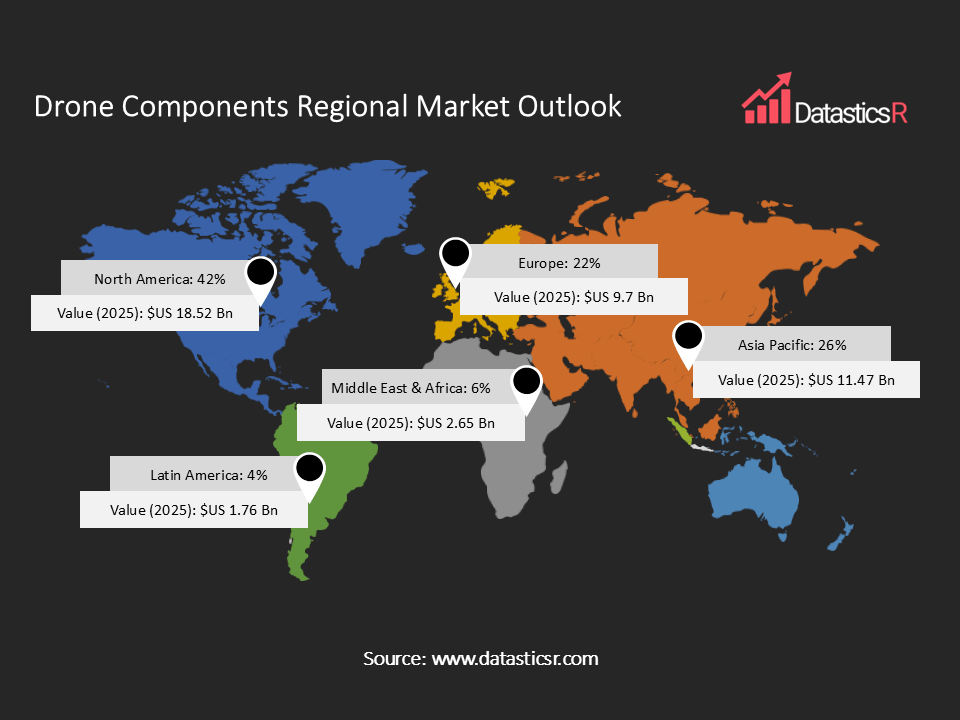
North America is the largest market for drone components, with an estimated 42% market share, driven by the U.S. defense procurement pipeline, an evolving FAA Part 108 beyond-visual-line-of-sight regulatory framework, and an accelerating domestic component-manufacturing buildout in response to NDAA and FCC sourcing restrictions.
Asia Pacific accounts for an estimated 26% share and is the fastest-growing region, anchored by China’s dominant drone and component manufacturing base, India’s rapidly expanding civilian drone ecosystem, and rising defense drone programs across the region.
Europe holds an estimated 22% share, supported by the EU’s U-space regulatory framework for networked low-altitude operations and a rapidly scaling loitering-munition and FPV-drone manufacturing base across Ukraine and NATO’s eastern-flank states.
Latin America and the Middle East & Africa represent 4% and 6% shares respectively, reflecting smaller but steadily growing agricultural, infrastructure, and security-driven drone adoption.
Asia Pacific accounts for an estimated 26% share and is the fastest-growing region, anchored by China’s dominant drone and component manufacturing base, India’s rapidly expanding civilian drone ecosystem, and rising defense drone programs across the region.
Europe holds an estimated 22% share, supported by the EU’s U-space regulatory framework for networked low-altitude operations and a rapidly scaling loitering-munition and FPV-drone manufacturing base across Ukraine and NATO’s eastern-flank states.
Latin America and the Middle East & Africa represent 4% and 6% shares respectively, reflecting smaller but steadily growing agricultural, infrastructure, and security-driven drone adoption.
Key Companies in Drone Components Market:
The competitive field spans large, vertically integrated platform manufacturers that also produce their own core components, specialized component-only suppliers, and a fast-growing cohort of NDAA-compliant domestic manufacturers created specifically in response to 2025-2026 sourcing restrictions. DJI-Innovations remains the dominant global supplier of motors, batteries, gimbals, and cameras despite new U.S. market restrictions, while T-Motor (Tmotor) is a leading independent global propulsion supplier. Ambarella and Teledyne FLIR lead in vision-processing chips and EO/IR camera payloads respectively, u-blox and Septentrio lead in GNSS/navigation modules, and Auterion supplies an open flight-control and autonomy software stack used across both commercial and defense platforms. On the domestic/NDAA-compliant side, Unusual Machines, ePropelled, Vertiq, KULR Technology Group, CRG Defense, and Hoverfly Technologies have all scaled U.S.-based motor, battery, and propulsion production specifically to meet Blue UAS and Drone Dominance framework requirements.
Key players include DJI-Innovations, T-Motor (Tmotor), Ambarella Inc., Teledyne FLIR, Auterion AG, u-blox, Unusual Machines Corporation, ePropelled, Vertiq, KULR Technology Group and Others.
Key players include DJI-Innovations, T-Motor (Tmotor), Ambarella Inc., Teledyne FLIR, Auterion AG, u-blox, Unusual Machines Corporation, ePropelled, Vertiq, KULR Technology Group and Others.
Key Developments in Drone Components Market:
| 1. Domestic Battery and Motor Manufacturers Scale Up to Fill the NDAA-Compliant Supply Gap: In February 2026, KULR Technology Group and Texas-based Hylio announced a partnership to manufacture NDAA-compliant drone battery systems domestically, following Unusual Machines’ April 2026 announcement of roughly 15,000 motors per month in Orlando. |
| 2. FCC Covered List Expansion and Pentagon Drone Dominance Framework Reshape U.S. Component Sourcing: Between December 2025 and January 2026, the FCC expanded its Covered List to bar new equipment authorizations for foreign-made drones and critical components (motors, batteries, flight controllers, navigation systems, cameras, and data-transmission devices), including DJI, while the Pentagon’s phased Drone Dominance sourcing framework began requiring NDAA-compliant motor assembly, magnet sourcing disclosure, and full domestic traceability on a rolling schedule through 2027. |
Drone Components Market Attributes:
| Market Value, 2025 | $US 44.1 Billion |
| Forecasted Market Value, 2036 | $US 161 Billion |
| CAGR (2026-2036) | 11.4% |
| Analysis Period | 2021-2036 |
| Historic Period | 2021-2024 |
| Base Year | 2025 |
| Forecast Period | 2026-2036 |
| Volume Unit | Units |
| Value Unit | $US Billion |
| Market Segmentation | By Component
By Platform
By End-Use
By Region
|
| Companies Profiles |
|
| Customization Request | Available upon request |
1. Introduction
1.1. Report Scope
1.2. Market Segmentations and Definitions
1.3. Geographical Coverage
2. Executive Summary
2.1. Key Facts and Figures
2.2. Trends Impacting the Market
2.3. DatasticsR Growth Opportunity Matrix
3. Market Overview
3.1. Global Drone Components Market Analysis and Forecast, 2021-2036
3.1.1. Global Drone Components Market Size (Units)
3.1.2. Global Drone Components Market Size ($US Bn)
3.2. Key Market Trends
3.3. Technology Roadmap and Developments
3.4. Market Dynamics
3.4.1. Drivers
3.4.2. Restraints
3.4.3. Opportunities
3.5. Porter’s Five Forces Analysis
3.6. PESTL Analysis
3.7. Industry SWOT Analysis
3.8. Regulatory Landscape
3.9. Value Chain Analysis
3.9.1. List of Materials Suppliers
3.9.2. List of Manufacturers
3.9.3. List of Dealers / Distributors
3.9.4. List of Potential Customers
3.10. Impact of Current Geopolitical Scenario on the Market
4. Technical Analysis
4.1. Product Specifications Analysis
4.2. Technology Adoption and Emerging Technologies
4.3. R&D Trends and Patents Landscape
4.4. Cost Structure and Profitability Analysis
5. Global Production Output Analysis (Units), by Region, 2025
5.1. North America
5.2. Europe
5.3. Asia Pacific
5.4. Latin America
5.5. Middle East and Africa
6. Import-export Analysis Volume (Units) and Value ($US Bn), by Key Country, 2021-2025
7. Price Trend Analysis and Forecasting ($US/Unit), 2021-2036
7.1. Price Trend Analysis and Forecasting, by Component
7.2. Price Trend Analysis and Forecasting, by Region
8. Global Drone Components Market Analysis and Forecasting (Units) ($US Bn), By Component, 2021-2036
9. Global Drone Components Market Analysis and Forecasting (Units) ($US Bn), by Platform, 2021-2036
10. Global Drone Components Market Analysis and Forecasting (Units) ($US Bn), by End-use, 2021-2036
11. Global Drone Components Market Analysis and Forecasting (Units) ($US Bn), by Region, 2021-2036
12. North America Drone Components Market Analysis and Forecasting (Units) ($US Bn), By Component, 2021-2036
13. North America Drone Components Market Analysis and Forecasting (Units) ($US Bn), by Platform, 2021-2036
14. North America Drone Components Market Analysis and Forecasting (Units) ($US Bn), by End-use, 2021-2036
15. U.S. Drone Components Market Analysis and Forecasting (Units) ($US Bn), By Component, 2021-2036
16. U.S. Drone Components Market Analysis and Forecasting (Units) ($US Bn), by Platform, 2021-2036
17. U.S. Drone Components Market Analysis and Forecasting (Units) ($US Bn), by End-use, 2021-2036
18. Canada Drone Components Market Analysis and Forecasting (Units) ($US Bn), By Component, 2021-2036
19. Canada Drone Components Market Analysis and Forecasting (Units) ($US Bn), by Platform, 2021-2036
20. Canada Drone Components Market Analysis and Forecasting (Units) ($US Bn), by End-use, 2021-2036
21. Europe Drone Components Market Analysis and Forecasting (Units) ($US Bn), By Component, 2021-2036
22. Europe Drone Components Market Analysis and Forecasting (Units) ($US Bn), by Platform, 2021-2036
23. Europe Drone Components Market Analysis and Forecasting (Units) ($US Bn), by End-use, 2021-2036
24. Germany Drone Components Market Analysis and Forecasting (Units) ($US Bn), By Component, 2021-2036
25. Germany Drone Components Market Analysis and Forecasting (Units) ($US Bn), by Platform, 2021-2036
26. Germany Drone Components Market Analysis and Forecasting (Units) ($US Bn), by End-use, 2021-2036
27. U.K. Drone Components Market Analysis and Forecasting (Units) ($US Bn), By Component, 2021-2036
28. U.K. Drone Components Market Analysis and Forecasting (Units) ($US Bn), by Platform, 2021-2036
29. U.K. Drone Components Market Analysis and Forecasting (Units) ($US Bn), by End-use, 2021-2036
30. France Drone Components Market Analysis and Forecasting (Units) ($US Bn), By Component, 2021-2036
31. France Drone Components Market Analysis and Forecasting (Units) ($US Bn), by Platform, 2021-2036
32. France Drone Components Market Analysis and Forecasting (Units) ($US Bn), by End-use, 2021-2036
33. Italy Drone Components Market Analysis and Forecasting (Units) ($US Bn), By Component, 2021-2036
34. Italy Drone Components Market Analysis and Forecasting (Units) ($US Bn), by Platform, 2021-2036
35. Italy Drone Components Market Analysis and Forecasting (Units) ($US Bn), by End-use, 2021-2036
36. Spain Drone Components Market Analysis and Forecasting (Units) ($US Bn), By Component, 2021-2036
37. Spain Drone Components Market Analysis and Forecasting (Units) ($US Bn), by Platform, 2021-2036
38. Spain Drone Components Market Analysis and Forecasting (Units) ($US Bn), by End-use, 2021-2036
39. Russia & CIS Drone Components Market Analysis and Forecasting (Units) ($US Bn), By Component, 2021-2036
40. Russia & CIS Drone Components Market Analysis and Forecasting (Units) ($US Bn), by Platform, 2021-2036
41. Russia & CIS Drone Components Market Analysis and Forecasting (Units) ($US Bn), by End-use, 2021-2036
42. Rest of Europe Drone Components Market Analysis and Forecasting (Units) ($US Bn), By Component, 2021-2036
43. Rest of Europe Drone Components Market Analysis and Forecasting (Units) ($US Bn), by Platform, 2021-2036
44. Rest of Europe Drone Components Market Analysis and Forecasting (Units) ($US Bn), by End-use, 2021-2036
45. Asia Pacific Drone Components Market Analysis and Forecasting (Units) ($US Bn), By Component, 2021-2036
46. Asia Pacific Drone Components Market Analysis and Forecasting (Units) ($US Bn), by Platform, 2021-2036
47. Asia Pacific Drone Components Market Analysis and Forecasting (Units) ($US Bn), by End-use, 2021-2036
48. China Drone Components Market Analysis and Forecasting (Units) ($US Bn), By Component, 2021-2036
49. China Drone Components Market Analysis and Forecasting (Units) ($US Bn), by Platform, 2021-2036
50. China Drone Components Market Analysis and Forecasting (Units) ($US Bn), by End-use, 2021-2036
51. India Drone Components Market Analysis and Forecasting (Units) ($US Bn), By Component, 2021-2036
52. India Drone Components Market Analysis and Forecasting (Units) ($US Bn), by Platform, 2021-2036
53. India Drone Components Market Analysis and Forecasting (Units) ($US Bn), by End-use, 2021-2036
54. Japan Drone Components Market Analysis and Forecasting (Units) ($US Bn), By Component, 2021-2036
55. Japan Drone Components Market Analysis and Forecasting (Units) ($US Bn), by Platform, 2021-2036
56. Japan Drone Components Market Analysis and Forecasting (Units) ($US Bn), by End-use, 2021-2036
57. South Korea Drone Components Market Analysis and Forecasting (Units) ($US Bn), By Component, 2021-2036
58. South Korea Drone Components Market Analysis and Forecasting (Units) ($US Bn), by Platform, 2021-2036
59. South Korea Drone Components Market Analysis and Forecasting (Units) ($US Bn), by End-use, 2021-2036
60. Taiwan Drone Components Market Analysis and Forecasting (Units) ($US Bn), By Component, 2021-2036
61. Taiwan Drone Components Market Analysis and Forecasting (Units) ($US Bn), by Platform, 2021-2036
62. Taiwan Drone Components Market Analysis and Forecasting (Units) ($US Bn), by End-use, 2021-2036
63. Australia Drone Components Market Analysis and Forecasting (Units) ($US Bn), By Component, 2021-2036
64. Australia Drone Components Market Analysis and Forecasting (Units) ($US Bn), by Platform, 2021-2036
65. Australia Drone Components Market Analysis and Forecasting (Units) ($US Bn), by End-use, 2021-2036
66. ASEAN Drone Components Market Analysis and Forecasting (Units) ($US Bn), By Component, 2021-2036
67. ASEAN Drone Components Market Analysis and Forecasting (Units) ($US Bn), by Platform, 2021-2036
68. ASEAN Drone Components Market Analysis and Forecasting (Units) ($US Bn), by End-use, 2021-2036
69. Rest of Asia Pacific Drone Components Market Analysis and Forecasting (Units) ($US Bn), By Component, 2021-2036
70. Rest of Asia Pacific Drone Components Market Analysis and Forecasting (Units) ($US Bn), by Platform, 2021-2036
71. Rest of Asia Pacific Drone Components Market Analysis and Forecasting (Units) ($US Bn), by End-use, 2021-2036
72. Latin America Drone Components Market Analysis and Forecasting (Units) ($US Bn), By Component, 2021-2036
73. Latin America Drone Components Market Analysis and Forecasting (Units) ($US Bn), by Platform, 2021-2036
74. Latin America Drone Components Market Analysis and Forecasting (Units) ($US Bn), by End-use, 2021-2036
75. Brazil Drone Components Market Analysis and Forecasting (Units) ($US Bn), By Component, 2021-2036
76. Brazil Drone Components Market Analysis and Forecasting (Units) ($US Bn), by Platform, 2021-2036
77. Brazil Drone Components Market Analysis and Forecasting (Units) ($US Bn), by End-use, 2021-2036
78. Mexico Drone Components Market Analysis and Forecasting (Units) ($US Bn), By Component, 2021-2036
79. Mexico Drone Components Market Analysis and Forecasting (Units) ($US Bn), by Platform, 2021-2036
80. Mexico Drone Components Market Analysis and Forecasting (Units) ($US Bn), by End-use, 2021-2036
81. Argentina Drone Components Market Analysis and Forecasting (Units) ($US Bn), By Component, 2021-2036
82. Argentina Drone Components Market Analysis and Forecasting (Units) ($US Bn), by Platform, 2021-2036
83. Argentina Drone Components Market Analysis and Forecasting (Units) ($US Bn), by End-use, 2021-2036
84. Rest of Latin America Drone Components Market Analysis and Forecasting (Units) ($US Bn), By Component, 2021-2036
85. Rest of Latin America Drone Components Market Analysis and Forecasting (Units) ($US Bn), by Platform, 2021-2036
86. Rest of Latin America Drone Components Market Analysis and Forecasting (Units) ($US Bn), by End-use, 2021-2036
87. Middle East & Africa Drone Components Market Analysis and Forecasting (Units) ($US Bn), By Component, 2021-2036
88. Middle East & Africa Drone Components Market Analysis and Forecasting (Units) ($US Bn), by Platform, 2021-2036
89. Middle East & Africa Drone Components Market Analysis and Forecasting (Units) ($US Bn), by End-use, 2021-2036
90. Saudi Arabia Drone Components Market Analysis and Forecasting (Units) ($US Bn), By Component, 2021-2036
91. Saudi Arabia Drone Components Market Analysis and Forecasting (Units) ($US Bn), by Platform, 2021-2036
92. Saudi Arabia Drone Components Market Analysis and Forecasting (Units) ($US Bn), by End-use, 2021-2036
93. UAE Drone Components Market Analysis and Forecasting (Units) ($US Bn), By Component, 2021-2036
94. UAE Drone Components Market Analysis and Forecasting (Units) ($US Bn), by Platform, 2021-2036
95. UAE Drone Components Market Analysis and Forecasting (Units) ($US Bn), by End-use, 2021-2036
96. South Africa Drone Components Market Analysis and Forecasting (Units) ($US Bn), By Component, 2021-2036
97. South Africa Drone Components Market Analysis and Forecasting (Units) ($US Bn), by Platform, 2021-2036
98. South Africa Drone Components Market Analysis and Forecasting (Units) ($US Bn), by End-use, 2021-2036
99. Rest of Middle East & Africa Drone Components Market Analysis and Forecasting (Units) ($US Bn), By Component, 2021-2036
100. Rest of Middle East & Africa Drone Components Market Analysis and Forecasting (Units) ($US Bn), by Platform, 2021-2036
101. Rest of Middle East & Africa Drone Components Market Analysis and Forecasting (Units) ($US Bn), by End-use, 2021-2036
102. Competition Landscape
102.1. Market Share Analysis (%), by Company, 2025
102.2. Competitive Benchmarking
102.3. Company Profiles
102.3.1. DJI-Innovations
102.3.1.1. Company Overview
102.3.1.2. Business Portfolio
102.3.1.3. Financials
102.3.1.4. Geographical Footprint
102.3.1.5. SWOT Analysis
102.3.1.6. Recent Developments and Strategies
102.3.2. T-Motor (Tmotor)
102.3.2.1. Company Overview
102.3.2.2. Business Portfolio
102.3.2.3. Financials
102.3.2.4. Geographical Footprint
102.3.2.5. SWOT Analysis
102.3.2.6. Recent Developments and Strategies
102.3.3. Ambarella Inc.
102.3.3.1. Company Overview
102.3.3.2. Business Portfolio
102.3.3.3. Financials
102.3.3.4. Geographical Footprint
102.3.3.5. SWOT Analysis
102.3.3.6. Recent Developments and Strategies
102.3.4. Teledyne FLIR
102.3.4.1. Company Overview
102.3.4.2. Business Portfolio
102.3.4.3. Financials
102.3.4.4. Geographical Footprint
102.3.4.5. SWOT Analysis
102.3.4.6. Recent Developments and Strategies
102.3.5. Auterion AG
102.3.5.1. Company Overview
102.3.5.2. Business Portfolio
102.3.5.3. Financials
102.3.5.4. Geographical Footprint
102.3.5.5. SWOT Analysis
102.3.5.6. Recent Developments and Strategies
102.3.6. u-blox
102.3.6.1. Company Overview
102.3.6.2. Business Portfolio
102.3.6.3. Financials
102.3.6.4. Geographical Footprint
102.3.6.5. SWOT Analysis
102.3.6.6. Recent Developments and Strategies
102.3.7. Unusual Machines Corporation
102.3.7.1. Company Overview
102.3.7.2. Business Portfolio
102.3.7.3. Financials
102.3.7.4. Geographical Footprint
102.3.7.5. SWOT Analysis
102.3.7.6. Recent Developments and Strategies
102.3.8. ePropelled
102.3.8.1. Company Overview
102.3.8.2. Business Portfolio
102.3.8.3. Financials
102.3.8.4. Geographical Footprint
102.3.8.5. SWOT Analysis
102.3.8.6. Recent Developments and Strategies
102.3.9. Vertiq
102.3.9.1. Company Overview
102.3.9.2. Business Portfolio
102.3.9.3. Financials
102.3.9.4. Geographical Footprint
102.3.9.5. SWOT Analysis
102.3.9.6. Recent Developments and Strategies
102.3.10. KULR Technology Group
102.3.10.1. Company Overview
102.3.10.2. Business Portfolio
102.3.10.3. Financials
102.3.10.4. Geographical Footprint
102.3.10.5. SWOT Analysis
102.3.10.6. Recent Developments and Strategies
102.3.11. Others
103. Appendix

- Get Started -
Get insights that lead to new growth opportunities
- Talk to Experts -
Get answers to your queries on this report from our experts
Frequently Asked Questions
The global Drone Components market in 2025 was $US 44.1 Billion.
The global Drone Components market will be $US 161 Billion by 2036.
What is the expected growth rate (CAGR%) of global Drone Components market for the period 2026-2036?
The expected growth rate (CAGR%) of the global Drone Components market is 11.4% for the period 2026-2036.
Defense Reshoring and NDAA/FCC-Driven Domestic Component Sourcing Mandates and Mass-Scale Loitering Munition and FPV Strike-Drone Production Driving Commodity Component Demand.
Defense & Military was the largest segment in End-use with around 45% revenue share among all in Drone Components Market in 2025.
North America was the leading regions for Drone Components holding 42% of the global market in 2025.
DJI-Innovations, T-Motor (Tmotor), Ambarella Inc., Teledyne FLIR, Auterion AG, u-blox, Unusual Machines Corporation, ePropelled, Vertiq, KULR Technology Group and Others.