

Defense Cybersecurity Market
Defense Cybersecurity Market (Component: Solutions and Services; Security Type: Network Security, Endpoint Security, Application Security, Cloud Security, Identity & Access Management and Others; Deployment Mode: On-Premises, Cloud and Hybrid; Application: Network & Communications Security, Command & Control Systems Protection, Weapons & Platform Systems Security, Intelligence & Data Security, Supply Chain & Industrial Base Security, and Satellite & Space Systems Security; End-User: Army, Navy, Air Force and Defense Contractors) – Global Industry Analysis, Shares, Growth, Trends and Forecast 2021-2036
Categories:
All, Information and Communication Technology (ICT)
| Format: PDF/PPT/Excel
| Product ID:
4892
| Report Version:
October 2026
- Report Preview
- Table of Content
- Request Customization
Market Snappshot
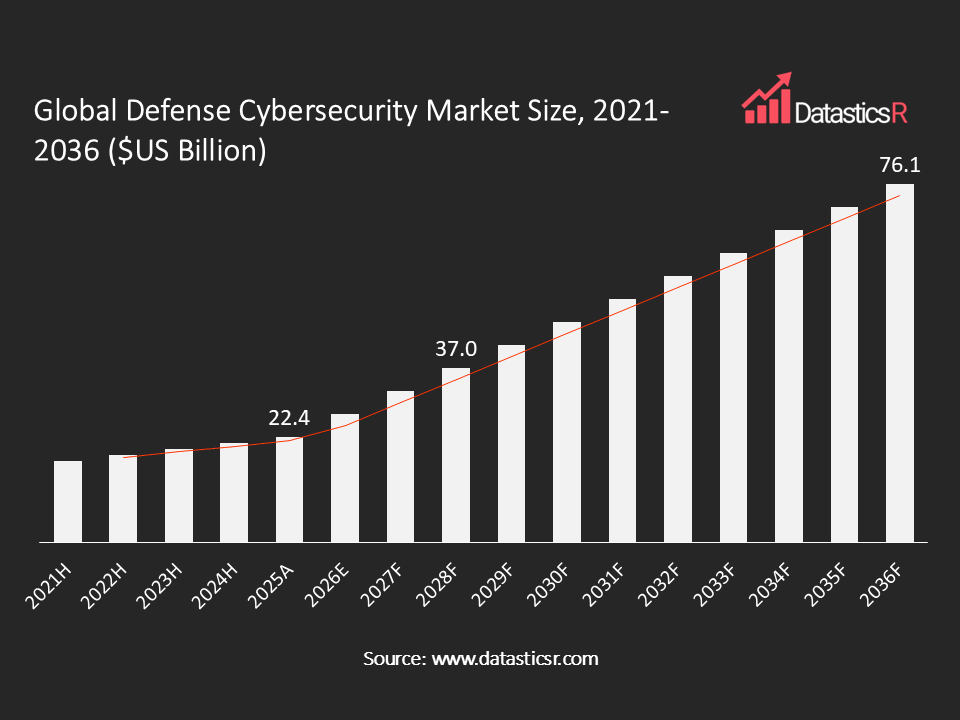
- Market Size in 2025: $US 22.4 Bn
- Forecast Market by 2036: $US 76.1 Bn
- CAGR for the Period 2026-2036: 10.8%
- Top Region in Terms of Market Share: North America (41%)
- Key Players: Booz Allen Hamilton Inc., Leidos Holdings Inc., General Dynamics Corporation, Lockheed Martin Corporation, RTX Corporation, Northrop Grumman Corporation, and Others.
Analyst Viewpoint:
Defense cybersecurity has quietly graduated from being a subset of IT security spend into a warfighting domain in its own right, treated by military planners as standing alongside land, sea, air, and space rather than beneath them. That is not merely rhetorical framing, it changes budget authority, acquisition timelines, and how quickly new capability gets fielded, and it is a large part of why growth in this category has consistently outpaced enterprise cybersecurity spending more broadly. The more instructive structural story is the widening gap between compliance mechanisms and actual security posture. Certification-based frameworks are useful for establishing a baseline and an audit trail, but they are inherently backward-looking, they verify a known, static state, while the systems they are meant to protect increasingly include autonomous AI decision-support tools, cryptography that will need to withstand quantum-computing threats, and space-based assets, all of which demand forward-looking, capability-based investment that a compliance checklist alone cannot capture. Regulators are visibly struggling with this mismatch: certification regimes have been paused, revised, and re-scoped multiple times in the past year alone as policymakers try to keep pace with the technology they are supposed to be certifying. The more interesting long-term dynamic is that this market’s growth is less a story of rising threat awareness than of the defense establishment’s own modernization generating the demand it must then defend. Every new connected weapons platform, every cloud migration, every satellite constellation is simultaneously a capability gain and a new set of endpoints for an adversary to target, meaning the attack surface this market exists to protect is expanding at roughly the same pace as the military capability it enables.
Defense Cybersecurity Market Overview:
Defense cybersecurity comprises the software, hardware, and services used to protect military networks, command-and-control systems, weapons platforms, tactical communications, intelligence data, and the broader defense industrial base supply chain against cyberattacks, spanning everything from network monitoring and endpoint protection to identity verification and supply-chain risk management.
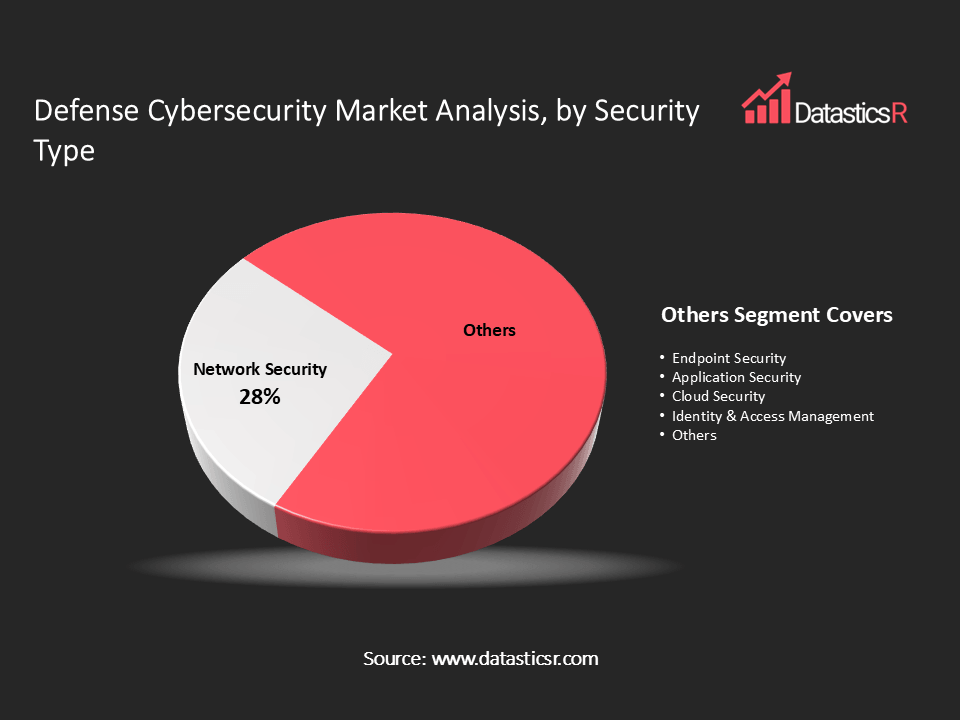
By component, solutions hold the largest share at an estimated 62%, while services, encompassing managed security, compliance advisory, and continuous monitoring, is the fastest-growing component as defense organizations and contractors increasingly outsource specialized cyber-operations capability rather than building it entirely in-house. By security type, network security leads with an estimated 28% share given its role as the foundational layer of military communications protection, while identity and access management, at an estimated 14% share today, is the fastest-growing security type, propelled by the shift toward zero-trust architectures that require continuous authentication of every user and device rather than perimeter-based trust. By deployment mode, on-premises deployment leads the market given the classified and air-gapped nature of many military networks, while cloud deployment is the fastest-growing mode as defense organizations expand secure government-cloud adoption. By application, network and communications security leads with an estimated 28% share, while satellite and space systems security is the fastest-growing application as military space assets expand. By end-user, the army holds the largest individual share followed by the air force and the navy, while defense contractors, at an estimated 42% share, represent both the single largest end-user category and the fastest-growing one, reflecting expanding supply-chain security requirements now being extended contractually from prime military networks down to their commercial suppliers.
The defining trend reshaping this market is the extension of cybersecurity requirements beyond traditional information technology into operational technology, weapons systems, and space-based assets, alongside the early introduction of post-quantum cryptography requirements into defense-contractor certification frameworks, ahead of full technical readiness across the industrial base.
By component, solutions hold the largest share at an estimated 62%, while services, encompassing managed security, compliance advisory, and continuous monitoring, is the fastest-growing component as defense organizations and contractors increasingly outsource specialized cyber-operations capability rather than building it entirely in-house. By security type, network security leads with an estimated 28% share given its role as the foundational layer of military communications protection, while identity and access management, at an estimated 14% share today, is the fastest-growing security type, propelled by the shift toward zero-trust architectures that require continuous authentication of every user and device rather than perimeter-based trust. By deployment mode, on-premises deployment leads the market given the classified and air-gapped nature of many military networks, while cloud deployment is the fastest-growing mode as defense organizations expand secure government-cloud adoption. By application, network and communications security leads with an estimated 28% share, while satellite and space systems security is the fastest-growing application as military space assets expand. By end-user, the army holds the largest individual share followed by the air force and the navy, while defense contractors, at an estimated 42% share, represent both the single largest end-user category and the fastest-growing one, reflecting expanding supply-chain security requirements now being extended contractually from prime military networks down to their commercial suppliers.
The defining trend reshaping this market is the extension of cybersecurity requirements beyond traditional information technology into operational technology, weapons systems, and space-based assets, alongside the early introduction of post-quantum cryptography requirements into defense-contractor certification frameworks, ahead of full technical readiness across the industrial base.
| Drivers | Nation-State Cyber Threats and Zero-Trust Mandates Driving Large-Scale Defense IT Security Modernization |
| Post-Quantum Cryptography Requirements and Evolving Supply-Chain Certification Standards Reshaping Contractor Cybersecurity Investment |
Nation-State Cyber Threats and Zero-Trust Mandates Driving Large-Scale Defense IT Security Modernization
Military networks, command systems, and the contractors that build and maintain them face persistent, well-resourced nation-state threats globally, and defense ministries across multiple regions have responded with the same fundamental architectural shift, moving away from perimeter-based security toward zero-trust models that continuously authenticate every user, device, and system rather than trusting anything inside a network boundary by default. In the United States, the Department of Defense has set a target of achieving zero-trust cybersecurity across every component by September 30, 2027, and is preparing to extend these requirements beyond conventional information technology into operational technology and weapons systems for the first time.
This is not a US-only shift. In January 2026, NATO adopted its Alliance Digital Strategy, formally committing all member states to embed zero-trust principles across NATO’s digital infrastructure and to accelerate adoption of post-quantum cryptography alliance-wide, alongside an updated 2026 Cyber Defence Pledge that now requires mandatory cybersecurity maturity assessments for critical infrastructure, standardized 24-hour incident reporting, and joint cyber-exercise participation across all member states. In the Indo-Pacific, the US-Japan-Australia-India Quad Cybersecurity Partnership is coordinating regional cyber capacity building, Australia has committed roughly $1.3 billion to a cyber capability program explicitly designed for interoperability with US systems, and Japan has treated cybersecurity as a strategic pillar of national security policy since 2022, with a steadily rising dedicated cyber-defense budget.
Because zero-trust architecture touches identity verification, network segmentation, endpoint monitoring, and application security simultaneously, and because this shift is being mandated by defense institutions on at least three continents in parallel rather than by any single government, this driver is reinforcing identity and access management as the fastest-growing security-type segment on a genuinely global basis.
This is not a US-only shift. In January 2026, NATO adopted its Alliance Digital Strategy, formally committing all member states to embed zero-trust principles across NATO’s digital infrastructure and to accelerate adoption of post-quantum cryptography alliance-wide, alongside an updated 2026 Cyber Defence Pledge that now requires mandatory cybersecurity maturity assessments for critical infrastructure, standardized 24-hour incident reporting, and joint cyber-exercise participation across all member states. In the Indo-Pacific, the US-Japan-Australia-India Quad Cybersecurity Partnership is coordinating regional cyber capacity building, Australia has committed roughly $1.3 billion to a cyber capability program explicitly designed for interoperability with US systems, and Japan has treated cybersecurity as a strategic pillar of national security policy since 2022, with a steadily rising dedicated cyber-defense budget.
Because zero-trust architecture touches identity verification, network segmentation, endpoint monitoring, and application security simultaneously, and because this shift is being mandated by defense institutions on at least three continents in parallel rather than by any single government, this driver is reinforcing identity and access management as the fastest-growing security-type segment on a genuinely global basis.
Post-Quantum Cryptography Requirements and Evolving Supply-Chain Certification Standards Reshaping Contractor Cybersecurity Investment
Supply-chain security certification has become one of the most consequential, and most volatile, forces shaping contractor-side cybersecurity investment. The U.S. Cybersecurity Maturity Model Certification framework began phasing into defense procurement in November 2025, with a more demanding third-party assessment phase originally scheduled for November 2026, before the Department of Defense suspended that second phase in July 2026 pending further review, an abrupt regulatory reversal that has left contractors continuing to invest in underlying security controls even as the certification mechanism itself remains in flux.
Layered on top of this is a new post-quantum cryptography requirement: the Pentagon’s post-quantum cryptography strategy directs quantum-resistant algorithms to be incorporated into access control, zero-trust infrastructure, and software development platforms, and into future iterations of the CMMC framework itself, even though independent experts and contractors widely acknowledge that the underlying technology and the industrial base’s readiness to implement it are not yet mature.
This combination, a compliance regime that keeps changing shape alongside a forward-looking technical requirement that has no fully mature implementation path yet, is unusual even by defense-acquisition standards, and is reinforcing defense contractors and the broader industrial base as the fastest-growing end-user segment as they invest ahead of, rather than strictly in response to, finalized certification requirements.
Layered on top of this is a new post-quantum cryptography requirement: the Pentagon’s post-quantum cryptography strategy directs quantum-resistant algorithms to be incorporated into access control, zero-trust infrastructure, and software development platforms, and into future iterations of the CMMC framework itself, even though independent experts and contractors widely acknowledge that the underlying technology and the industrial base’s readiness to implement it are not yet mature.
This combination, a compliance regime that keeps changing shape alongside a forward-looking technical requirement that has no fully mature implementation path yet, is unusual even by defense-acquisition standards, and is reinforcing defense contractors and the broader industrial base as the fastest-growing end-user segment as they invest ahead of, rather than strictly in response to, finalized certification requirements.
Defense Cybersecurity Regional Market Outlook:
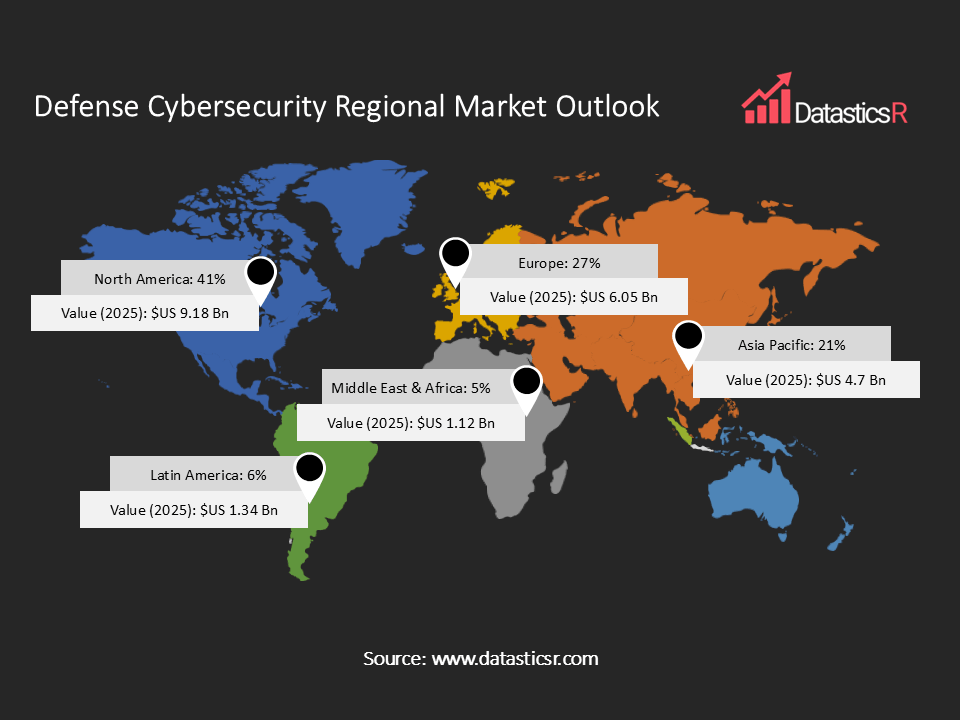
North America is the largest market for defense cybersecurity, with an estimated 41% market share, underpinned by the world’s largest defense budget, an extensive and mature defense industrial base subject to supply-chain certification requirements, and sustained multi-billion-dollar zero-trust and cloud-security modernization spending.
Europe accounts for an estimated 27% market share, driven by rising national defense-investment commitments, expanding NATO cyber-defense cooperation, and growing national cyber-command capabilities across member states responding to sustained regional security concerns.
Asia Pacific holds an estimated 21% share and is the fastest-growing region, as Japan, South Korea, India, and other regional powers accelerate investment in sovereign cyber-defense capability, secure cloud infrastructure, and satellite-network protection amid evolving regional security dynamics.
Latin America and the Middle East & Africa each represent an estimated 6% and 5% share respectively, reflecting smaller but steadily growing defense-modernization and cyber-capability investment across both regions.
Europe accounts for an estimated 27% market share, driven by rising national defense-investment commitments, expanding NATO cyber-defense cooperation, and growing national cyber-command capabilities across member states responding to sustained regional security concerns.
Asia Pacific holds an estimated 21% share and is the fastest-growing region, as Japan, South Korea, India, and other regional powers accelerate investment in sovereign cyber-defense capability, secure cloud infrastructure, and satellite-network protection amid evolving regional security dynamics.
Latin America and the Middle East & Africa each represent an estimated 6% and 5% share respectively, reflecting smaller but steadily growing defense-modernization and cyber-capability investment across both regions.
Key Companies in Defense Cybersecurity Market:
The competitive field is led by large, diversified defense primes with deep systems-integration and classified-network heritage, alongside specialized government-services firms built around cybersecurity and intelligence-support work. Booz Allen Hamilton Inc., Leidos Holdings Inc., General Dynamics Corporation, and CACI International Inc. compete primarily as managed cybersecurity and IT-modernization service providers to defense and intelligence agencies, while Lockheed Martin Corporation, RTX Corporation, Northrop Grumman Corporation, L3Harris Technologies Inc., and BAE Systems plc integrate cybersecurity directly into weapons platforms, C4ISR systems, and space assets they also manufacture. Palantir Technologies Inc. has built a significant position in AI-enabled data security and decision-support platforms operating inside classified defense networks. Competitive activity has centered on zero-trust implementation contracts, classified-environment AI security architecture, and supply-chain compliance advisory services as certification requirements continue to evolve.
Key players include Booz Allen Hamilton Inc., Leidos Holdings Inc., General Dynamics Corporation, Lockheed Martin Corporation, RTX Corporation, Northrop Grumman Corporation, L3Harris Technologies Inc., BAE Systems plc, Palantir Technologies Inc., CACI International Inc. and Others.
Key players include Booz Allen Hamilton Inc., Leidos Holdings Inc., General Dynamics Corporation, Lockheed Martin Corporation, RTX Corporation, Northrop Grumman Corporation, L3Harris Technologies Inc., BAE Systems plc, Palantir Technologies Inc., CACI International Inc. and Others.
Key Developments in Defense Cybersecurity Market:
| 1. DoD Suspends CMMC Phase 2 Third-Party Assessment Requirement: On July 13, 2026, the U.S. Department of Defense announced the immediate suspension of Cybersecurity Maturity Model Certification Phase 2, which had been scheduled to take effect on November 10, 2026 and would have required independent third-party assessment for contracts involving controlled unclassified information, freezing Phases 3 and 4 pending further review. |
| 2. Pentagon Prepares Zero Trust Strategy 2.0 Extending Requirements to Operational Technology and Weapons Systems: In December 2025, the Pentagon’s Zero Trust Portfolio Management Office confirmed plans to publish an updated zero-trust strategy around March 2026, extending its 91 existing IT-focused cybersecurity capability outcomes to cover operational technology and weapons systems for the first time. |
Defense Cybersecurity Market Attributes:
| Market Value, 2025 | $US 22.4 Billion |
| Forecasted Market Value, 2036 | $US 76.1 Billion |
| CAGR (2026-2036) | 10.8% |
| Analysis Period | 2021-2036 |
| Historic Period | 2021-2024 |
| Base Year | 2025 |
| Forecast Period | 2026-2036 |
| Volume Unit | N/A |
| Value Unit | $US Billion |
| Market Segmentation | By Component
By Security Type
By Deployment Mode
By Application
By End-User
By Region
|
| Companies Profiles |
|
| Customization Request | Available upon request |
1. Introduction
1.1. Report Scope
1.2. Market Segmentations and Definitions
1.3. Geographical Coverage
2. Executive Summary
2.1. Key Facts and Figures
2.2. Trends Impacting the Market
2.3. DatasticsR Growth Opportunity Matrix
3. Market Overview
3.1. Global Defense Cybersecurity Market Analysis and Forecast, 2021-2036
3.1.1. Global Defense Cybersecurity Market Size ($US Bn)
3.2. Key Market Trends
3.3. Technology Roadmap and Developments
3.4. Market Dynamics
3.4.1. Drivers
3.4.2. Restraints
3.4.3. Opportunities
3.5. Porter’s Five Forces Analysis
3.6. PESTL Analysis
3.7. Industry SWOT Analysis
3.8. Regulatory Landscape
3.9. Value Chain Analysis
3.9.1. List of Technology Providers
3.9.2. List of System Integrators
3.9.3. List of End-users / Potential Customers
3.10. Impact of Current Geopolitical Scenario on the Market
4. Technical Analysis
4.1. Specifications Analysis
4.2. Technology Adoption and Emerging Trends
4.3. R&D Trends and Patents Landscape
4.4. Cost Structure and Profitability Analysis
5. Global Analysis ($US Bn), by Region, 2025
5.1. North America
5.2. Europe
5.3. Asia Pacific
5.4. Latin America
5.5. Middle East and Africa
6. Global Defense Cybersecurity Market Analysis and Forecasting ($US Bn), by Component, 2021-2036
7. Global Defense Cybersecurity Market Analysis and Forecasting ($US Bn), By Security Type, 2021-2036
8. Global Defense Cybersecurity Market Analysis and Forecasting ($US Bn), by Deployment Mode, 2021-2036
9. Global Defense Cybersecurity Market Analysis and Forecasting ($US Bn), by Application, 2021-2036
10. Global Defense Cybersecurity Market Analysis and Forecasting ($US Bn), by End-user, 2021-2036
11. Global Defense Cybersecurity Market Analysis and Forecasting ($US Bn), by Region, 2021-2036
12. North America Defense Cybersecurity Market Analysis and Forecasting ($US Bn), by Component, 2021-2036
13. North America Defense Cybersecurity Market Analysis and Forecasting ($US Bn), By Security Type, 2021-2036
14. North America Defense Cybersecurity Market Analysis and Forecasting ($US Bn), by Deployment Mode, 2021-2036
15. North America Defense Cybersecurity Market Analysis and Forecasting ($US Bn), by Application, 2021-2036
16. North America Defense Cybersecurity Market Analysis and Forecasting ($US Bn), by End-user, 2021-2036
17. U.S. Defense Cybersecurity Market Analysis and Forecasting ($US Bn), by Component, 2021-2036
18. U.S. Defense Cybersecurity Market Analysis and Forecasting ($US Bn), By Security Type, 2021-2036
19. U.S. Defense Cybersecurity Market Analysis and Forecasting ($US Bn), by Deployment Mode, 2021-2036
20. U.S. Defense Cybersecurity Market Analysis and Forecasting ($US Bn), by Application, 2021-2036
21. U.S. Defense Cybersecurity Market Analysis and Forecasting ($US Bn), by End-user, 2021-2036
22. Canada Defense Cybersecurity Market Analysis and Forecasting ($US Bn), by Component, 2021-2036
23. Canada Defense Cybersecurity Market Analysis and Forecasting ($US Bn), By Security Type, 2021-2036
24. Canada Defense Cybersecurity Market Analysis and Forecasting ($US Bn), by Deployment Mode, 2021-2036
25. Canada Defense Cybersecurity Market Analysis and Forecasting ($US Bn), by Application, 2021-2036
26. Canada Defense Cybersecurity Market Analysis and Forecasting ($US Bn), by End-user, 2021-2036
27. Europe Defense Cybersecurity Market Analysis and Forecasting ($US Bn), by Component, 2021-2036
28. Europe Defense Cybersecurity Market Analysis and Forecasting ($US Bn), By Security Type, 2021-2036
29. Europe Defense Cybersecurity Market Analysis and Forecasting ($US Bn), by Deployment Mode, 2021-2036
30. Europe Defense Cybersecurity Market Analysis and Forecasting ($US Bn), by Application, 2021-2036
31. Europe Defense Cybersecurity Market Analysis and Forecasting ($US Bn), by End-user, 2021-2036
32. Germany Defense Cybersecurity Market Analysis and Forecasting ($US Bn), by Component, 2021-2036
33. Germany Defense Cybersecurity Market Analysis and Forecasting ($US Bn), By Security Type, 2021-2036
34. Germany Defense Cybersecurity Market Analysis and Forecasting ($US Bn), by Deployment Mode, 2021-2036
35. Germany Defense Cybersecurity Market Analysis and Forecasting ($US Bn), by Application, 2021-2036
36. Germany Defense Cybersecurity Market Analysis and Forecasting ($US Bn), by End-user, 2021-2036
37. U.K. Defense Cybersecurity Market Analysis and Forecasting ($US Bn), by Component, 2021-2036
38. U.K. Defense Cybersecurity Market Analysis and Forecasting ($US Bn), By Security Type, 2021-2036
39. U.K. Defense Cybersecurity Market Analysis and Forecasting ($US Bn), by Deployment Mode, 2021-2036
40. U.K. Defense Cybersecurity Market Analysis and Forecasting ($US Bn), by Application, 2021-2036
41. U.K. Defense Cybersecurity Market Analysis and Forecasting ($US Bn), by End-user, 2021-2036
42. France Defense Cybersecurity Market Analysis and Forecasting ($US Bn), by Component, 2021-2036
43. France Defense Cybersecurity Market Analysis and Forecasting ($US Bn), By Security Type, 2021-2036
44. France Defense Cybersecurity Market Analysis and Forecasting ($US Bn), by Deployment Mode, 2021-2036
45. France Defense Cybersecurity Market Analysis and Forecasting ($US Bn), by Application, 2021-2036
46. France Defense Cybersecurity Market Analysis and Forecasting ($US Bn), by End-user, 2021-2036
47. Italy Defense Cybersecurity Market Analysis and Forecasting ($US Bn), by Component, 2021-2036
48. Italy Defense Cybersecurity Market Analysis and Forecasting ($US Bn), By Security Type, 2021-2036
49. Italy Defense Cybersecurity Market Analysis and Forecasting ($US Bn), by Deployment Mode, 2021-2036
50. Italy Defense Cybersecurity Market Analysis and Forecasting ($US Bn), by Application, 2021-2036
51. Italy Defense Cybersecurity Market Analysis and Forecasting ($US Bn), by End-user, 2021-2036
52. Spain Defense Cybersecurity Market Analysis and Forecasting ($US Bn), by Component, 2021-2036
53. Spain Defense Cybersecurity Market Analysis and Forecasting ($US Bn), By Security Type, 2021-2036
54. Spain Defense Cybersecurity Market Analysis and Forecasting ($US Bn), by Deployment Mode, 2021-2036
55. Spain Defense Cybersecurity Market Analysis and Forecasting ($US Bn), by Application, 2021-2036
56. Spain Defense Cybersecurity Market Analysis and Forecasting ($US Bn), by End-user, 2021-2036
57. Russia & CIS Defense Cybersecurity Market Analysis and Forecasting ($US Bn), by Component, 2021-2036
58. Russia & CIS Defense Cybersecurity Market Analysis and Forecasting ($US Bn), By Security Type, 2021-2036
59. Russia & CIS Defense Cybersecurity Market Analysis and Forecasting ($US Bn), by Deployment Mode, 2021-2036
60. Russia & CIS Defense Cybersecurity Market Analysis and Forecasting ($US Bn), by Application, 2021-2036
61. Russia & CIS Defense Cybersecurity Market Analysis and Forecasting ($US Bn), by End-user, 2021-2036
62. Rest of Europe Defense Cybersecurity Market Analysis and Forecasting ($US Bn), by Component, 2021-2036
63. Rest of Europe Defense Cybersecurity Market Analysis and Forecasting ($US Bn), By Security Type, 2021-2036
64. Rest of Europe Defense Cybersecurity Market Analysis and Forecasting ($US Bn), by Deployment Mode, 2021-2036
65. Rest of Europe Defense Cybersecurity Market Analysis and Forecasting ($US Bn), by Application, 2021-2036
66. Rest of Europe Defense Cybersecurity Market Analysis and Forecasting ($US Bn), by End-user, 2021-2036
67. Asia Pacific Defense Cybersecurity Market Analysis and Forecasting ($US Bn), by Component, 2021-2036
68. Asia Pacific Defense Cybersecurity Market Analysis and Forecasting ($US Bn), By Security Type, 2021-2036
69. Asia Pacific Defense Cybersecurity Market Analysis and Forecasting ($US Bn), by Deployment Mode, 2021-2036
70. Asia Pacific Defense Cybersecurity Market Analysis and Forecasting ($US Bn), by Application, 2021-2036
71. Asia Pacific Defense Cybersecurity Market Analysis and Forecasting ($US Bn), by End-user, 2021-2036
72. China Defense Cybersecurity Market Analysis and Forecasting ($US Bn), by Component, 2021-2036
73. China Defense Cybersecurity Market Analysis and Forecasting ($US Bn), By Security Type, 2021-2036
74. China Defense Cybersecurity Market Analysis and Forecasting ($US Bn), by Deployment Mode, 2021-2036
75. China Defense Cybersecurity Market Analysis and Forecasting ($US Bn), by Application, 2021-2036
76. China Defense Cybersecurity Market Analysis and Forecasting ($US Bn), by End-user, 2021-2036
77. India Defense Cybersecurity Market Analysis and Forecasting ($US Bn), by Component, 2021-2036
78. India Defense Cybersecurity Market Analysis and Forecasting ($US Bn), By Security Type, 2021-2036
79. India Defense Cybersecurity Market Analysis and Forecasting ($US Bn), by Deployment Mode, 2021-2036
80. India Defense Cybersecurity Market Analysis and Forecasting ($US Bn), by Application, 2021-2036
81. India Defense Cybersecurity Market Analysis and Forecasting ($US Bn), by End-user, 2021-2036
82. Japan Defense Cybersecurity Market Analysis and Forecasting ($US Bn), by Component, 2021-2036
83. Japan Defense Cybersecurity Market Analysis and Forecasting ($US Bn), By Security Type, 2021-2036
84. Japan Defense Cybersecurity Market Analysis and Forecasting ($US Bn), by Deployment Mode, 2021-2036
85. Japan Defense Cybersecurity Market Analysis and Forecasting ($US Bn), by Application, 2021-2036
86. Japan Defense Cybersecurity Market Analysis and Forecasting ($US Bn), by End-user, 2021-2036
87. South Korea Defense Cybersecurity Market Analysis and Forecasting ($US Bn), by Component, 2021-2036
88. South Korea Defense Cybersecurity Market Analysis and Forecasting ($US Bn), By Security Type, 2021-2036
89. South Korea Defense Cybersecurity Market Analysis and Forecasting ($US Bn), by Deployment Mode, 2021-2036
90. South Korea Defense Cybersecurity Market Analysis and Forecasting ($US Bn), by Application, 2021-2036
91. South Korea Defense Cybersecurity Market Analysis and Forecasting ($US Bn), by End-user, 2021-2036
92. Taiwan Defense Cybersecurity Market Analysis and Forecasting ($US Bn), by Component, 2021-2036
93. Taiwan Defense Cybersecurity Market Analysis and Forecasting ($US Bn), By Security Type, 2021-2036
94. Taiwan Defense Cybersecurity Market Analysis and Forecasting ($US Bn), by Deployment Mode, 2021-2036
95. Taiwan Defense Cybersecurity Market Analysis and Forecasting ($US Bn), by Application, 2021-2036
96. Taiwan Defense Cybersecurity Market Analysis and Forecasting ($US Bn), by End-user, 2021-2036
97. Australia Defense Cybersecurity Market Analysis and Forecasting ($US Bn), by Component, 2021-2036
98. Australia Defense Cybersecurity Market Analysis and Forecasting ($US Bn), By Security Type, 2021-2036
99. Australia Defense Cybersecurity Market Analysis and Forecasting ($US Bn), by Deployment Mode, 2021-2036
100. Australia Defense Cybersecurity Market Analysis and Forecasting ($US Bn), by Application, 2021-2036
101. Australia Defense Cybersecurity Market Analysis and Forecasting ($US Bn), by End-user, 2021-2036
102. ASEAN Defense Cybersecurity Market Analysis and Forecasting ($US Bn), by Component, 2021-2036
103. ASEAN Defense Cybersecurity Market Analysis and Forecasting ($US Bn), By Security Type, 2021-2036
104. ASEAN Defense Cybersecurity Market Analysis and Forecasting ($US Bn), by Deployment Mode, 2021-2036
105. ASEAN Defense Cybersecurity Market Analysis and Forecasting ($US Bn), by Application, 2021-2036
106. ASEAN Defense Cybersecurity Market Analysis and Forecasting ($US Bn), by End-user, 2021-2036
107. Rest of Asia Pacific Defense Cybersecurity Market Analysis and Forecasting ($US Bn), by Component, 2021-2036
108. Rest of Asia Pacific Defense Cybersecurity Market Analysis and Forecasting ($US Bn), By Security Type, 2021-2036
109. Rest of Asia Pacific Defense Cybersecurity Market Analysis and Forecasting ($US Bn), by Deployment Mode, 2021-2036
110. Rest of Asia Pacific Defense Cybersecurity Market Analysis and Forecasting ($US Bn), by Application, 2021-2036
111. Rest of Asia Pacific Defense Cybersecurity Market Analysis and Forecasting ($US Bn), by End-user, 2021-2036
112. Latin America Defense Cybersecurity Market Analysis and Forecasting ($US Bn), by Component, 2021-2036
113. Latin America Defense Cybersecurity Market Analysis and Forecasting ($US Bn), By Security Type, 2021-2036
114. Latin America Defense Cybersecurity Market Analysis and Forecasting ($US Bn), by Deployment Mode, 2021-2036
115. Latin America Defense Cybersecurity Market Analysis and Forecasting ($US Bn), by Application, 2021-2036
116. Latin America Defense Cybersecurity Market Analysis and Forecasting ($US Bn), by End-user, 2021-2036
117. Brazil Defense Cybersecurity Market Analysis and Forecasting ($US Bn), by Component, 2021-2036
118. Brazil Defense Cybersecurity Market Analysis and Forecasting ($US Bn), By Security Type, 2021-2036
119. Brazil Defense Cybersecurity Market Analysis and Forecasting ($US Bn), by Deployment Mode, 2021-2036
120. Brazil Defense Cybersecurity Market Analysis and Forecasting ($US Bn), by Application, 2021-2036
121. Brazil Defense Cybersecurity Market Analysis and Forecasting ($US Bn), by End-user, 2021-2036
122. Mexico Defense Cybersecurity Market Analysis and Forecasting ($US Bn), by Component, 2021-2036
123. Mexico Defense Cybersecurity Market Analysis and Forecasting ($US Bn), By Security Type, 2021-2036
124. Mexico Defense Cybersecurity Market Analysis and Forecasting ($US Bn), by Deployment Mode, 2021-2036
125. Mexico Defense Cybersecurity Market Analysis and Forecasting ($US Bn), by Application, 2021-2036
126. Mexico Defense Cybersecurity Market Analysis and Forecasting ($US Bn), by End-user, 2021-2036
127. Argentina Defense Cybersecurity Market Analysis and Forecasting ($US Bn), by Component, 2021-2036
128. Argentina Defense Cybersecurity Market Analysis and Forecasting ($US Bn), By Security Type, 2021-2036
129. Argentina Defense Cybersecurity Market Analysis and Forecasting ($US Bn), by Deployment Mode, 2021-2036
130. Argentina Defense Cybersecurity Market Analysis and Forecasting ($US Bn), by Application, 2021-2036
131. Argentina Defense Cybersecurity Market Analysis and Forecasting ($US Bn), by End-user, 2021-2036
132. Rest of Latin America Defense Cybersecurity Market Analysis and Forecasting ($US Bn), by Component, 2021-2036
133. Rest of Latin America Defense Cybersecurity Market Analysis and Forecasting ($US Bn), By Security Type, 2021-2036
134. Rest of Latin America Defense Cybersecurity Market Analysis and Forecasting ($US Bn), by Deployment Mode, 2021-2036
135. Rest of Latin America Defense Cybersecurity Market Analysis and Forecasting ($US Bn), by Application, 2021-2036
136. Rest of Latin America Defense Cybersecurity Market Analysis and Forecasting ($US Bn), by End-user, 2021-2036
137. Middle East & Africa Defense Cybersecurity Market Analysis and Forecasting ($US Bn), by Component, 2021-2036
138. Middle East & Africa Defense Cybersecurity Market Analysis and Forecasting ($US Bn), By Security Type, 2021-2036
139. Middle East & Africa Defense Cybersecurity Market Analysis and Forecasting ($US Bn), by Deployment Mode, 2021-2036
140. Middle East & Africa Defense Cybersecurity Market Analysis and Forecasting ($US Bn), by Application, 2021-2036
141. Middle East & Africa Defense Cybersecurity Market Analysis and Forecasting ($US Bn), by End-user, 2021-2036
142. Saudi Arabia Defense Cybersecurity Market Analysis and Forecasting ($US Bn), by Component, 2021-2036
143. Saudi Arabia Defense Cybersecurity Market Analysis and Forecasting ($US Bn), By Security Type, 2021-2036
144. Saudi Arabia Defense Cybersecurity Market Analysis and Forecasting ($US Bn), by Deployment Mode, 2021-2036
145. Saudi Arabia Defense Cybersecurity Market Analysis and Forecasting ($US Bn), by Application, 2021-2036
146. Saudi Arabia Defense Cybersecurity Market Analysis and Forecasting ($US Bn), by End-user, 2021-2036
147. UAE Defense Cybersecurity Market Analysis and Forecasting ($US Bn), by Component, 2021-2036
148. UAE Defense Cybersecurity Market Analysis and Forecasting ($US Bn), By Security Type, 2021-2036
149. UAE Defense Cybersecurity Market Analysis and Forecasting ($US Bn), by Deployment Mode, 2021-2036
150. UAE Defense Cybersecurity Market Analysis and Forecasting ($US Bn), by Application, 2021-2036
151. UAE Defense Cybersecurity Market Analysis and Forecasting ($US Bn), by End-user, 2021-2036
152. South Africa Defense Cybersecurity Market Analysis and Forecasting ($US Bn), by Component, 2021-2036
153. South Africa Defense Cybersecurity Market Analysis and Forecasting ($US Bn), By Security Type, 2021-2036
154. South Africa Defense Cybersecurity Market Analysis and Forecasting ($US Bn), by Deployment Mode, 2021-2036
155. South Africa Defense Cybersecurity Market Analysis and Forecasting ($US Bn), by Application, 2021-2036
156. South Africa Defense Cybersecurity Market Analysis and Forecasting ($US Bn), by End-user, 2021-2036
157. Rest of Middle East & Africa Defense Cybersecurity Market Analysis and Forecasting ($US Bn), by Component, 2021-2036
158. Rest of Middle East & Africa Defense Cybersecurity Market Analysis and Forecasting ($US Bn), By Security Type, 2021-2036
159. Rest of Middle East & Africa Defense Cybersecurity Market Analysis and Forecasting ($US Bn), by Deployment Mode, 2021-2036
160. Rest of Middle East & Africa Defense Cybersecurity Market Analysis and Forecasting ($US Bn), by Application, 2021-2036
161. Rest of Middle East & Africa Defense Cybersecurity Market Analysis and Forecasting ($US Bn), by End-user, 2021-2036
162. Competition Landscape
162.1. Market Share Analysis (%), by Company, 2025
162.2. Competitive Benchmarking
162.3. Company Profiles
162.3.1. Booz Allen Hamilton Inc.
162.3.1.1. Company Overview
162.3.1.2. Business Portfolio
162.3.1.3. Financials
162.3.1.4. Geographical Footprint
162.3.1.5. SWOT Analysis
162.3.1.6. Recent Developments and Strategies
162.3.2. Leidos Holdings Inc.
162.3.2.1. Company Overview
162.3.2.2. Business Portfolio
162.3.2.3. Financials
162.3.2.4. Geographical Footprint
162.3.2.5. SWOT Analysis
162.3.2.6. Recent Developments and Strategies
162.3.3. General Dynamics Corporation
162.3.3.1. Company Overview
162.3.3.2. Business Portfolio
162.3.3.3. Financials
162.3.3.4. Geographical Footprint
162.3.3.5. SWOT Analysis
162.3.3.6. Recent Developments and Strategies
162.3.4. Lockheed Martin Corporation
162.3.4.1. Company Overview
162.3.4.2. Business Portfolio
162.3.4.3. Financials
162.3.4.4. Geographical Footprint
162.3.4.5. SWOT Analysis
162.3.4.6. Recent Developments and Strategies
162.3.5. RTX Corporation
162.3.5.1. Company Overview
162.3.5.2. Business Portfolio
162.3.5.3. Financials
162.3.5.4. Geographical Footprint
162.3.5.5. SWOT Analysis
162.3.5.6. Recent Developments and Strategies
162.3.6. Northrop Grumman Corporation
162.3.6.1. Company Overview
162.3.6.2. Business Portfolio
162.3.6.3. Financials
162.3.6.4. Geographical Footprint
162.3.6.5. SWOT Analysis
162.3.6.6. Recent Developments and Strategies
162.3.7. L3Harris Technologies Inc.
162.3.7.1. Company Overview
162.3.7.2. Business Portfolio
162.3.7.3. Financials
162.3.7.4. Geographical Footprint
162.3.7.5. SWOT Analysis
162.3.7.6. Recent Developments and Strategies
162.3.8. BAE Systems
162.3.8.1. Company Overview
162.3.8.2. Business Portfolio
162.3.8.3. Financials
162.3.8.4. Geographical Footprint
162.3.8.5. SWOT Analysis
162.3.8.6. Recent Developments and Strategies
162.3.9. Palantir Technologies Inc.
162.3.9.1. Company Overview
162.3.9.2. Business Portfolio
162.3.9.3. Financials
162.3.9.4. Geographical Footprint
162.3.9.5. SWOT Analysis
162.3.9.6. Recent Developments and Strategies
162.3.10. CACI International Inc.
162.3.10.1. Company Overview
162.3.10.2. Business Portfolio
162.3.10.3. Financials
162.3.10.4. Geographical Footprint
162.3.10.5. SWOT Analysis
162.3.10.6. Recent Developments and Strategies
162.3.11. Others
163. Appendix

- Get Started -
Get insights that lead to new growth opportunities
- Talk to Experts -
Get answers to your queries on this report from our experts
Frequently Asked Questions
The global Defense Cybersecurity market in 2025 was $US 22.4 Billion.
The global Defense Cybersecurity market will be $US 76.1 Billion by 2036.
The expected growth rate (CAGR%) of the global Defense Cybersecurity market is 10.8% for the period 2026-2036.
Nation-State Cyber Threats and Zero-Trust Mandates Driving Large-Scale Defense IT Security Modernization and Post-Quantum Cryptography Requirements and Evolving Supply-Chain Certification Standards Reshaping Contractor Cybersecurity Investment.
Network Security was the largest segment in Security Type with around 28% revenue share among all in Defense Cybersecurity Market in 2025.
North America was the leading regions for Defense Cybersecurity holding 41% of the global market in 2025.
Booz Allen Hamilton Inc., Leidos Holdings Inc., General Dynamics Corporation, Lockheed Martin Corporation, RTX Corporation, Northrop Grumman Corporation, L3Harris Technologies Inc., BAE Systems plc, Palantir Technologies Inc., CACI International Inc. and Others.