

Autonomous Buildings Market
Autonomous Buildings Market (Building Type: Mission-critical (Data Centers, Semiconductor Fabs, Healthcare Facilities, Airports & Transportation Hubs and Others), Residential, Commercial, Industrial and Others; Building System: HVAC Control, Lighting Management, Energy Management, Security & Access Control, Fire & Life Safety Systems, Water & Waste Management, Asset & Maintenance Management and Others; Technology: Artificial Intelligence (AI), Digital Twins, Internet of Things (IoT), Edge Computing, Cloud Computing, Advanced Building Management Systems (BMS), Predictive Analytics, Robotics & Autonomous Inspection and Others; Level of Autonomy: Assisted, Semi-Autonomous and Fully Autonomous) – Global Industry Analysis, Shares, Growth, Trends and Forecast 2021-2036
| Format: PDF/PPT/Excel
| Product ID:
4518
| Report Version:
June 2026
- Report Preview
- Table of Content
- Request Customization
Market Snappshot
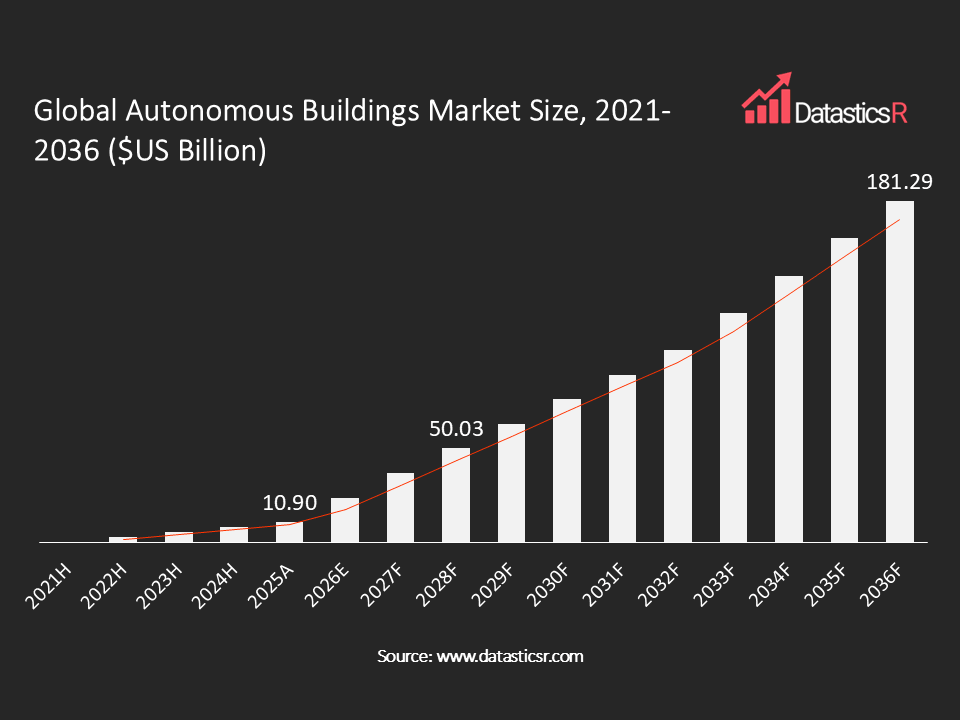
- Market Size in 2025: $US 10.9 Bn
- Forecast Market by 2036: $US 181.29 Bn
- CAGR for the Period 2026-2036: 22.4%
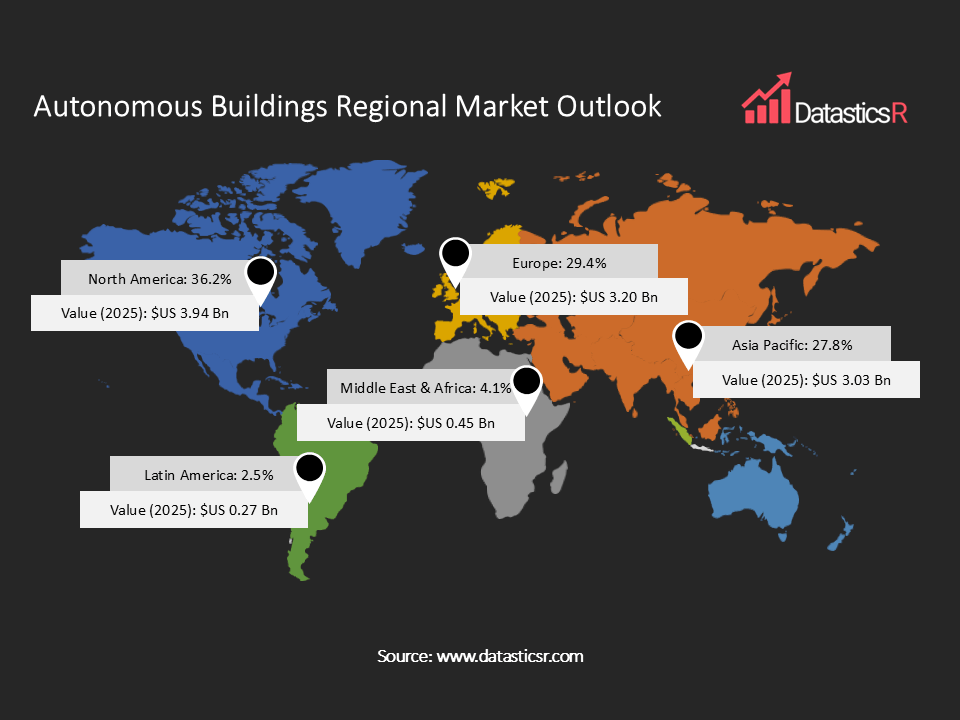
- Top Region in Terms of Market Share: North America (36.2%)
- Key Players: Johnson Controls, Siemens, Honeywell, Schneider Electric, ABB, Cisco, Legrand, Delta Electronics, IBM, Microsoft, Google, Trane Technologies and Others
Analyst Viewpoint:
The Autonomous Buildings market is bringing about changes in the buildings’ space enabling facility to go beyond the conventional smart buildings and create intelligent buildings with real-time decisions without or minimal human intervention. Increased energy prices, labor scarcity, stricter environmental policies and escalating intricacy in the critical infrastructure are spurring the growth of Autonomous Buildings Solutions across the globe. While buildings are responsible for nearly 30 percent of the global energy consumption and 26 percent of energy-related carbon emissions, enterprises are increasingly prompted to deploy energy efficient and intelligent buildings. Key technologies supporting the Autonomous Buildings Market are Artificial intelligence (AI), digital twin, IoT sensors, edge computing and predictive analytics, which through AI-Powered Building Management and robust automation platforms empower building systems to optimize heating, cooling, lighting, security, maintenance, and energy consumption in real-time. Emergence of self-optimizing buildings supports continuous enhancement in performance while decreasing operating expenses and resource consumptions. AI in Building Operations aids in identifying anomalies, detecting early signs of equipment failures and enhancing occupant comfort by leveraging data-driven decisions. Sector such as data centers, semiconductor fabrication, airports, hospitals, advanced manufacturing facilities and more is experiencing high adoption of Autonomous Buildings owing to high financial and operational losses with system downtimes. These organizations are highly motivated to build Mission-Critical Autonomous Buildings to maintain operations and achieve resilience. The market growth however faces hindrances such as high costs of implementations, lack of system interoperability, integration of existing old infrastructure and cybersecurity threats.
Autonomous Buildings Market Overview:
The Autonomous Buildings Market is a paradigm shift from smart buildings towards intelligent infrastructure of the future. While smart buildings operated based on predefined rules and programmed responses, autonomous buildings learn from operational data and adapt accordingly by making decisions in isolation. These buildings are built using connected sensors, automated systems and intelligent software that enable integrated digital spaces that are capable of sensing, diagnosing and reacting to dynamic environments.
In modern autonomous buildings, building automation systems (BAS) are integrated with cloud computing, edge computing and advanced analytics capabilities in order to control heating, cooling, ventilation and lighting; provide security, fire and water management as well as enable monitoring and maintenance functions. Increasingly, the adoption of autonomous facility management platforms is enabling the organizations to reduce operation costs while boosting building performance and the comfort level of the occupant.
The Autonomous Buildings Market was valued at US$10.9 billion in 2025 and is expected to grow to US$181.29 billion in 2036, growing at a CAGR of 22.4% over the forecast period. The increasing implementation of Digital Twin Buildings, IoT connectivity, predictive analytics and automation technologies will continue to support the market growth. According to studies, the prediction of equipment failure can decrease equipment failure by as much as 70% with maintenance costs reduced by about 25%. Autonomous asset management will be valued with the growing complexity of facility buildings. Increasing investment in digital infrastructure further enhances this adoption, and organizations like data centers that leverage AI, semiconductor manufacturing plants with high environment requirements and those working towards achieving net-zero goals are using autonomous energy management platforms to improve energy efficiency, resilience and sustainability.
In modern autonomous buildings, building automation systems (BAS) are integrated with cloud computing, edge computing and advanced analytics capabilities in order to control heating, cooling, ventilation and lighting; provide security, fire and water management as well as enable monitoring and maintenance functions. Increasingly, the adoption of autonomous facility management platforms is enabling the organizations to reduce operation costs while boosting building performance and the comfort level of the occupant.
The Autonomous Buildings Market was valued at US$10.9 billion in 2025 and is expected to grow to US$181.29 billion in 2036, growing at a CAGR of 22.4% over the forecast period. The increasing implementation of Digital Twin Buildings, IoT connectivity, predictive analytics and automation technologies will continue to support the market growth. According to studies, the prediction of equipment failure can decrease equipment failure by as much as 70% with maintenance costs reduced by about 25%. Autonomous asset management will be valued with the growing complexity of facility buildings. Increasing investment in digital infrastructure further enhances this adoption, and organizations like data centers that leverage AI, semiconductor manufacturing plants with high environment requirements and those working towards achieving net-zero goals are using autonomous energy management platforms to improve energy efficiency, resilience and sustainability.
| Drivers | Growing Adoption of AI-Powered Self-Optimizing Building Operations |
| Expanding Mission-Critical Infrastructure Driving Autonomous Building Adoption |
Growing Adoption of AI-Powered Self-Optimizing Building Operations
The growth of Artificial Intelligence in building management has been the core enabler to reach the era of Autonomous Building infrastructures. Traditional Building management system, mainly based on preset rules whereas AI-driven Autonomous Building Management systems would analyze immense amount of data coming from the connected devices, occupancy patterns, sensors, climate information which enables the facilities to be managed based on the dynamically changing environment; optimize the overall efficiency, energy usage, occupant comfort and safety.
Increasing the application of AI & IoT Integration in Autonomous Buildings allows optimized functionality across multiple building operations in real time. Smart algorithms will adjust their parameters automatically based on varying factors such as occupancy levels, weather situations and equipment efficiency. In turn it will contribute to a massive decrease in energy usage while increasing operational efficiency.
Increasing use of Digital Twin Applications in Autonomous Buildings is optimizing the buildings further. It enables the facility managers to predict future scenarios and test various possible solutions before implementing it thereby maximizing the benefits and minimizing operational risks.
Another influential driver in market growth includes AI-based Predictive Maintenance for buildings. Facilities managers would predict any irregularities in the machines before it ceases to function thereby avoiding the maintenance requirement to the maximum extent. Predictive Maintenance can enhance equipment uptime from 10-20% while reducing the maintenance planning needs by 50%, states industry research. As organizations across the board aim to sustain in terms of operational efficiency, environmental resilience and sustainability, they are seeing Autonomous Building as the strategic long-term investment.
Increasing the application of AI & IoT Integration in Autonomous Buildings allows optimized functionality across multiple building operations in real time. Smart algorithms will adjust their parameters automatically based on varying factors such as occupancy levels, weather situations and equipment efficiency. In turn it will contribute to a massive decrease in energy usage while increasing operational efficiency.
Increasing use of Digital Twin Applications in Autonomous Buildings is optimizing the buildings further. It enables the facility managers to predict future scenarios and test various possible solutions before implementing it thereby maximizing the benefits and minimizing operational risks.
Another influential driver in market growth includes AI-based Predictive Maintenance for buildings. Facilities managers would predict any irregularities in the machines before it ceases to function thereby avoiding the maintenance requirement to the maximum extent. Predictive Maintenance can enhance equipment uptime from 10-20% while reducing the maintenance planning needs by 50%, states industry research. As organizations across the board aim to sustain in terms of operational efficiency, environmental resilience and sustainability, they are seeing Autonomous Building as the strategic long-term investment.
Expanding Mission-Critical Infrastructure Driving Autonomous Building Adoption
Expansion in Mission-Critical Autonomous Building Infrastructure has generated considerable market growth. Facilities such as data centers, semiconductor fabrication facilities, hospitals, airports, and high-tech manufacturing facilities demand operational reliability and cannot suffer long downtime. The growing operational complexity and performance requirements have made autonomous technologies an indispensable choice for ensuring continuous operations.
An increasing demand for AI, cloud computing and digital services has resulted in massive investments in hyperscale data centers around the globe. These facilities necessitate the smart management of their power distribution networks, cooling and environment control to ensure operations run around the clock, and hence, Autonomous Building Technologies for Data Centers have seen their widespread adoption by operators due to the demand for enhanced operational reliability.
High level precision is demanded for controlling the temperature, humidity, and contamination levels in semiconductor manufacturing facilities, and Autonomous Building Systems ensure such conditions are maintained without human intervention. Likewise, high-end Intelligent Building Automation for Healthcare Facilities has been adopted due to increasing demand in healthcare services. The energy-efficiency and climatic-resilience have also pushed for the adoption of Artificial Intelligence based heating, ventilation and air conditioning operations which contributes to Autonomous HVAC Control Systems Market growth.
An increasing demand for AI, cloud computing and digital services has resulted in massive investments in hyperscale data centers around the globe. These facilities necessitate the smart management of their power distribution networks, cooling and environment control to ensure operations run around the clock, and hence, Autonomous Building Technologies for Data Centers have seen their widespread adoption by operators due to the demand for enhanced operational reliability.
High level precision is demanded for controlling the temperature, humidity, and contamination levels in semiconductor manufacturing facilities, and Autonomous Building Systems ensure such conditions are maintained without human intervention. Likewise, high-end Intelligent Building Automation for Healthcare Facilities has been adopted due to increasing demand in healthcare services. The energy-efficiency and climatic-resilience have also pushed for the adoption of Artificial Intelligence based heating, ventilation and air conditioning operations which contributes to Autonomous HVAC Control Systems Market growth.
Autonomous Buildings Regional Market Outlook:
North America held a market share of 36.2% and is leading the market for Autonomous Buildings Market owing to the robust use of AI, digital twin technology, hyperscale data centers, and advanced building automation systems in U.S and Canada along with high investment in mission-critical infrastructure and smart building modernization projects.
Europe had a market share of 29.4% owing to the growing use of stringent sustainable regulations, net-zero buildings mandates, and use of intelligent building technology among Germany, the U.K, France and Nordic countries leading the smart autonomous building technology. The region continues to lead innovation within the broader Intelligent Buildings Market.
Asia Pacific has almost 27.8% market share and the most rapidly growing region. Owing to the rapid urbanization and smart city initiatives, increase in production of semiconductors, and high investment in digital infrastructure across China, Japan, South Korea, Singapore and India.
Middle East & Africa held about 4.1% market share and was led by smart city development and large infrastructure projects.
Latin America holds a market share of 2.5% on account of increased investment in commercial building and urban digitization projects.
Europe had a market share of 29.4% owing to the growing use of stringent sustainable regulations, net-zero buildings mandates, and use of intelligent building technology among Germany, the U.K, France and Nordic countries leading the smart autonomous building technology. The region continues to lead innovation within the broader Intelligent Buildings Market.
Asia Pacific has almost 27.8% market share and the most rapidly growing region. Owing to the rapid urbanization and smart city initiatives, increase in production of semiconductors, and high investment in digital infrastructure across China, Japan, South Korea, Singapore and India.
Middle East & Africa held about 4.1% market share and was led by smart city development and large infrastructure projects.
Latin America holds a market share of 2.5% on account of increased investment in commercial building and urban digitization projects.
Key Companies in Autonomous Buildings Market:
Autonomous Buildings market is somewhat concentrated. Competitive environment in this market is defined by building automation vendors, software firms, cloud infrastructure providers, and Artificial Intelligence technology companies. Companies in the top position are increasingly focusing on digital twin, predictive analysis, artificial intelligence driven building operation, autonomous building maintenance systems and integrated building platform. Collaboration between building automation vendors, cloud companies and AI software developers are frequently observed among the players in this market. End to end building automation system are preferred due to high ROI. Mission-critical applications are the prime focus areas in this market due to high ROI.
The key players in Autonomous Buildings market include Johnson Controls, Siemens, Honeywell, Schneider Electric, ABB, Cisco, Legrand, Delta Electronics, IBM, Microsoft, Google, Trane Technologies and Others.
The key players in Autonomous Buildings market include Johnson Controls, Siemens, Honeywell, Schneider Electric, ABB, Cisco, Legrand, Delta Electronics, IBM, Microsoft, Google, Trane Technologies and Others.
Key Developments in Autonomous Buildings Market:
| 1. Siemens Launches AI Tool for Autonomous Building Operations: In May 2026, Siemens Smart Infrastructure has introduced a new artificial intelligence-enabled managed building service designed to accelerate the transition toward human-centric autonomous building management. |
| 2. Trane Technologies Opens Global AI Lab and Showroom, Accelerating the Future of Autonomous Buildings: In May 2026, Trane Technologies, a global climate innovator, today unveiled the BrainBox AI Trane Technologies AI Lab and showroom in Montréal, Canada. The grand opening marks the latest milestone in the company’s strategy to accelerate the development of next-generation, AI-driven solutions that dramatically reduce energy consumption and carbon emissions in the built environment. |
Autonomous Buildings Market Attributes:
| ATTRIBUTE | DETAILS |
| Market Value, 2025 | $US 10.9 Billion |
| Forecasted Market Value, 2036 | $US 181.29 Billion |
| CAGR (2026-2036) | 22.4% |
| Analysis Period | 2021-2036 |
| Historic Period | 2021-2024 |
| Base Year | 2025 |
| Forecast Period | 2026-2036 |
| Volume Unit | NA |
| Value Unit | $US Billion |
| Market Segmentation | By Building Type
By Building System
By Technology
By Level of Autonomy
By Region
|
| Companies Profiles |
|
| Customization Request | Available upon request |
1. Introduction
1.1. Report Scope
1.2. Market Segmentations and Definitions
1.3. Geographical Coverage
2. Executive Summary
2.1. Key Facts and Figures
2.2. Trends Impacting the Market
2.3. DatasticsR Growth Opportunity Matrix
3. Market Overview
3.1. Global Autonomous Buildings Market Analysis and Forecast, 2021-2036
3.1.1. Global Autonomous Buildings Market Size ($US Bn)
3.2. Supply-side and Demand-side Trends
3.3. Technology Roadmap and Developments
3.4. Market Dynamics
3.4.1. Drivers
3.4.2. Restraints
3.4.3. Opportunities
3.5. Porter’s Five Forces Analysis
3.6. PESTL Analysis
3.7. Industry SWOT Analysis
3.8. Regulatory Landscape
3.9. Value Chain Analysis
3.9.1. List of Hardware and Component Suppliers
3.9.2. List of Software and AI Platform Providers
3.9.3. List of Networking and IoT Companies
3.9.4. List of Building Automation System (BAS) Providers
3.9.5. List of System Integrators / Engineering Companies
3.9.6. List of Potential Customers
3.10. Impact of Current Geopolitical Scenario on the Market
4. Technical Analysis
4.1. Autonomous Building Architecture Analysis
4.2. Details of System Integration Process
4.3. Technology Adoption and Emerging Technologies
4.4. R&D Trends and Patents Landscape
4.5. Cost Structure and Profitability Analysis
5. Global Autonomous Buildings Projects, by Region, 2025
5.1. North America
5.2. Europe
5.3. Asia Pacific
5.4. Latin America
5.5. Middle East and Africa
6. Global Autonomous Buildings Market Analysis and Forecasting ($US Bn), by Building Type, 2021-2036
7. Global Autonomous Buildings Market Analysis and Forecasting ($US Bn), by Building System, 2021-2036
8. Global Autonomous Buildings Market Analysis and Forecasting ($US Bn), by Technology, 2021-2036
9. Global Autonomous Buildings Market Analysis and Forecasting ($US Bn), by Level of Autonomy, 2021-2036
10. Global Autonomous Buildings Market Analysis and Forecasting ($US Bn), by Region, 2021-2036
11. North America Autonomous Buildings Market Analysis and Forecasting ($US Bn), by Building Type, 2021-2036
12. North America Autonomous Buildings Market Analysis and Forecasting ($US Bn), by Building System, 2021-2036
13. North America Autonomous Buildings Market Analysis and Forecasting ($US Bn), by Technology, 2021-2036
14. North America Autonomous Buildings Market Analysis and Forecasting ($US Bn), by Level of Autonomy, 2021-2036
15. U.S. Autonomous Buildings Market Analysis and Forecasting ($US Bn), by Building Type, 2021-2036
16. U.S. Autonomous Buildings Market Analysis and Forecasting ($US Bn), by Building System, 2021-2036
17. U.S. Autonomous Buildings Market Analysis and Forecasting ($US Bn), by Technology, 2021-2036
18. U.S. Autonomous Buildings Market Analysis and Forecasting ($US Bn), by Level of Autonomy, 2021-2036
19. Canada Autonomous Buildings Market Analysis and Forecasting ($US Bn), by Building Type, 2021-2036
20. Canada Autonomous Buildings Market Analysis and Forecasting ($US Bn), by Building System, 2021-2036
21. Canada Autonomous Buildings Market Analysis and Forecasting ($US Bn), by Technology, 2021-2036
22. Canada Autonomous Buildings Market Analysis and Forecasting ($US Bn), by Level of Autonomy, 2021-2036
23. Europe Autonomous Buildings Market Analysis and Forecasting ($US Bn), by Building Type, 2021-2036
24. Europe Autonomous Buildings Market Analysis and Forecasting ($US Bn), by Building System, 2021-2036
25. Europe Autonomous Buildings Market Analysis and Forecasting ($US Bn), by Technology, 2021-2036
26. Europe Autonomous Buildings Market Analysis and Forecasting ($US Bn), by Level of Autonomy, 2021-2036
27. Germany Autonomous Buildings Market Analysis and Forecasting ($US Bn), by Building Type, 2021-2036
28. Germany Autonomous Buildings Market Analysis and Forecasting ($US Bn), by Building System, 2021-2036
29. Germany Autonomous Buildings Market Analysis and Forecasting ($US Bn), by Technology, 2021-2036
30. Germany Autonomous Buildings Market Analysis and Forecasting ($US Bn), by Level of Autonomy, 2021-2036
31. U.K. Autonomous Buildings Market Analysis and Forecasting ($US Bn), by Building Type, 2021-2036
32. U.K. Autonomous Buildings Market Analysis and Forecasting ($US Bn), by Building System, 2021-2036
33. U.K. Autonomous Buildings Market Analysis and Forecasting ($US Bn), by Technology, 2021-2036
34. U.K. Autonomous Buildings Market Analysis and Forecasting ($US Bn), by Level of Autonomy, 2021-2036
35. France Autonomous Buildings Market Analysis and Forecasting ($US Bn), by Building Type, 2021-2036
36. France Autonomous Buildings Market Analysis and Forecasting ($US Bn), by Building System, 2021-2036
37. France Autonomous Buildings Market Analysis and Forecasting ($US Bn), by Technology, 2021-2036
38. France Autonomous Buildings Market Analysis and Forecasting ($US Bn), by Level of Autonomy, 2021-2036
39. Italy Autonomous Buildings Market Analysis and Forecasting ($US Bn), by Building Type, 2021-2036
40. Italy Autonomous Buildings Market Analysis and Forecasting ($US Bn), by Building System, 2021-2036
41. Italy Autonomous Buildings Market Analysis and Forecasting ($US Bn), by Technology, 2021-2036
42. Italy Autonomous Buildings Market Analysis and Forecasting ($US Bn), by Level of Autonomy, 2021-2036
43. Spain Autonomous Buildings Market Analysis and Forecasting ($US Bn), by Building Type, 2021-2036
44. Spain Autonomous Buildings Market Analysis and Forecasting ($US Bn), by Building System, 2021-2036
45. Spain Autonomous Buildings Market Analysis and Forecasting ($US Bn), by Technology, 2021-2036
46. Spain Autonomous Buildings Market Analysis and Forecasting ($US Bn), by Level of Autonomy, 2021-2036
47. Russia & CIS Autonomous Buildings Market Analysis and Forecasting ($US Bn), by Building Type, 2021-2036
48. Russia & CIS Autonomous Buildings Market Analysis and Forecasting ($US Bn), by Building System, 2021-2036
49. Russia & CIS Autonomous Buildings Market Analysis and Forecasting ($US Bn), by Technology, 2021-2036
50. Russia & CIS Autonomous Buildings Market Analysis and Forecasting ($US Bn), by Level of Autonomy, 2021-2036
51. Rest of Europe Autonomous Buildings Market Analysis and Forecasting ($US Bn), by Building Type, 2021-2036
52. Rest of Europe Autonomous Buildings Market Analysis and Forecasting ($US Bn), by Building System, 2021-2036
53. Rest of Europe Autonomous Buildings Market Analysis and Forecasting ($US Bn), by Technology, 2021-2036
54. Rest of Europe Autonomous Buildings Market Analysis and Forecasting ($US Bn), by Level of Autonomy, 2021-2036
55. Asia Pacific Autonomous Buildings Market Analysis and Forecasting ($US Bn), by Building Type, 2021-2036
56. Asia Pacific Autonomous Buildings Market Analysis and Forecasting ($US Bn), by Building System, 2021-2036
57. Asia Pacific Autonomous Buildings Market Analysis and Forecasting ($US Bn), by Technology, 2021-2036
58. Asia Pacific Autonomous Buildings Market Analysis and Forecasting ($US Bn), by Level of Autonomy, 2021-2036
59. China Autonomous Buildings Market Analysis and Forecasting ($US Bn), by Building Type, 2021-2036
60. China Autonomous Buildings Market Analysis and Forecasting ($US Bn), by Building System, 2021-2036
61. China Autonomous Buildings Market Analysis and Forecasting ($US Bn), by Technology, 2021-2036
62. China Autonomous Buildings Market Analysis and Forecasting ($US Bn), by Level of Autonomy, 2021-2036
63. India Autonomous Buildings Market Analysis and Forecasting ($US Bn), by Building Type, 2021-2036
64. India Autonomous Buildings Market Analysis and Forecasting ($US Bn), by Building System, 2021-2036
65. India Autonomous Buildings Market Analysis and Forecasting ($US Bn), by Technology, 2021-2036
66. India Autonomous Buildings Market Analysis and Forecasting ($US Bn), by Level of Autonomy, 2021-2036
67. Japan Autonomous Buildings Market Analysis and Forecasting ($US Bn), by Building Type, 2021-2036
68. Japan Autonomous Buildings Market Analysis and Forecasting ($US Bn), by Building System, 2021-2036
69. Japan Autonomous Buildings Market Analysis and Forecasting ($US Bn), by Technology, 2021-2036
70. Japan Autonomous Buildings Market Analysis and Forecasting ($US Bn), by Level of Autonomy, 2021-2036
71. South Korea Autonomous Buildings Market Analysis and Forecasting ($US Bn), by Building Type, 2021-2036
72. South Korea Autonomous Buildings Market Analysis and Forecasting ($US Bn), by Building System, 2021-2036
73. South Korea Autonomous Buildings Market Analysis and Forecasting ($US Bn), by Technology, 2021-2036
74. South Korea Autonomous Buildings Market Analysis and Forecasting ($US Bn), by Level of Autonomy, 2021-2036
75. Taiwan Autonomous Buildings Market Analysis and Forecasting ($US Bn), by Building Type, 2021-2036
76. Taiwan Autonomous Buildings Market Analysis and Forecasting ($US Bn), by Building System, 2021-2036
77. Taiwan Autonomous Buildings Market Analysis and Forecasting ($US Bn), by Technology, 2021-2036
78. Taiwan Autonomous Buildings Market Analysis and Forecasting ($US Bn), by Level of Autonomy, 2021-2036
79. Australia Autonomous Buildings Market Analysis and Forecasting ($US Bn), by Building Type, 2021-2036
80. Australia Autonomous Buildings Market Analysis and Forecasting ($US Bn), by Building System, 2021-2036
81. Australia Autonomous Buildings Market Analysis and Forecasting ($US Bn), by Technology, 2021-2036
82. Australia Autonomous Buildings Market Analysis and Forecasting ($US Bn), by Level of Autonomy, 2021-2036
83. ASEAN Autonomous Buildings Market Analysis and Forecasting ($US Bn), by Building Type, 2021-2036
84. ASEAN Autonomous Buildings Market Analysis and Forecasting ($US Bn), by Building System, 2021-2036
85. ASEAN Autonomous Buildings Market Analysis and Forecasting ($US Bn), by Technology, 2021-2036
86. ASEAN Autonomous Buildings Market Analysis and Forecasting ($US Bn), by Level of Autonomy, 2021-2036
87. Rest of Asia Pacific Autonomous Buildings Market Analysis and Forecasting ($US Bn), by Building Type, 2021-2036
88. Rest of Asia Pacific Autonomous Buildings Market Analysis and Forecasting ($US Bn), by Building System, 2021-2036
89. Rest of Asia Pacific Autonomous Buildings Market Analysis and Forecasting ($US Bn), by Technology, 2021-2036
90. Rest of Asia Pacific Autonomous Buildings Market Analysis and Forecasting ($US Bn), by Level of Autonomy, 2021-2036
91. Latin America Autonomous Buildings Market Analysis and Forecasting ($US Bn), by Building Type, 2021-2036
92. Latin America Autonomous Buildings Market Analysis and Forecasting ($US Bn), by Building System, 2021-2036
93. Latin America Autonomous Buildings Market Analysis and Forecasting ($US Bn), by Technology, 2021-2036
94. Latin America Autonomous Buildings Market Analysis and Forecasting ($US Bn), by Level of Autonomy, 2021-2036
95. Brazil Autonomous Buildings Market Analysis and Forecasting ($US Bn), by Building Type, 2021-2036
96. Brazil Autonomous Buildings Market Analysis and Forecasting ($US Bn), by Building System, 2021-2036
97. Brazil Autonomous Buildings Market Analysis and Forecasting ($US Bn), by Technology, 2021-2036
98. Brazil Autonomous Buildings Market Analysis and Forecasting ($US Bn), by Level of Autonomy, 2021-2036
99. Mexico Autonomous Buildings Market Analysis and Forecasting ($US Bn), by Building Type, 2021-2036
100. Mexico Autonomous Buildings Market Analysis and Forecasting ($US Bn), by Building System, 2021-2036
101. Mexico Autonomous Buildings Market Analysis and Forecasting ($US Bn), by Technology, 2021-2036
102. Mexico Autonomous Buildings Market Analysis and Forecasting ($US Bn), by Level of Autonomy, 2021-2036
103. Argentina Autonomous Buildings Market Analysis and Forecasting ($US Bn), by Building Type, 2021-2036
104. Argentina Autonomous Buildings Market Analysis and Forecasting ($US Bn), by Building System, 2021-2036
105. Argentina Autonomous Buildings Market Analysis and Forecasting ($US Bn), by Technology, 2021-2036
106. Argentina Autonomous Buildings Market Analysis and Forecasting ($US Bn), by Level of Autonomy, 2021-2036
107. Rest of Latin America Autonomous Buildings Market Analysis and Forecasting ($US Bn), by Building Type, 2021-2036
108. Rest of Latin America Autonomous Buildings Market Analysis and Forecasting ($US Bn), by Building System, 2021-2036
109. Rest of Latin America Autonomous Buildings Market Analysis and Forecasting ($US Bn), by Technology, 2021-2036
110. Rest of Latin America Autonomous Buildings Market Analysis and Forecasting ($US Bn), by Level of Autonomy, 2021-2036
111. Middle East & Africa Autonomous Buildings Market Analysis and Forecasting ($US Bn), by Building Type, 2021-2036
112. Middle East & Africa Autonomous Buildings Market Analysis and Forecasting ($US Bn), by Building System, 2021-2036
113. Middle East & Africa Autonomous Buildings Market Analysis and Forecasting ($US Bn), by Technology, 2021-2036
114. Middle East & Africa Autonomous Buildings Market Analysis and Forecasting ($US Bn), by Level of Autonomy, 2021-2036
115. Saudi Arabia Autonomous Buildings Market Analysis and Forecasting ($US Bn), by Building Type, 2021-2036
116. Saudi Arabia Autonomous Buildings Market Analysis and Forecasting ($US Bn), by Building System, 2021-2036
117. Saudi Arabia Autonomous Buildings Market Analysis and Forecasting ($US Bn), by Technology, 2021-2036
118. Saudi Arabia Autonomous Buildings Market Analysis and Forecasting ($US Bn), by Level of Autonomy, 2021-2036
119. UAE Autonomous Buildings Market Analysis and Forecasting ($US Bn), by Building Type, 2021-2036
120. UAE Autonomous Buildings Market Analysis and Forecasting ($US Bn), by Building System, 2021-2036
121. UAE Autonomous Buildings Market Analysis and Forecasting ($US Bn), by Technology, 2021-2036
122. UAE Autonomous Buildings Market Analysis and Forecasting ($US Bn), by Level of Autonomy, 2021-2036
123. South Africa Autonomous Buildings Market Analysis and Forecasting ($US Bn), by Building Type, 2021-2036
124. South Africa Autonomous Buildings Market Analysis and Forecasting ($US Bn), by Building System, 2021-2036
125. South Africa Autonomous Buildings Market Analysis and Forecasting ($US Bn), by Technology, 2021-2036
126. South Africa Autonomous Buildings Market Analysis and Forecasting ($US Bn), by Level of Autonomy, 2021-2036
127. Rest of Middle East & Africa Autonomous Buildings Market Analysis and Forecasting ($US Bn), by Building Type, 2021-2036
128. Rest of Middle East & Africa Autonomous Buildings Market Analysis and Forecasting ($US Bn), by Building System, 2021-2036
129. Rest of Middle East & Africa Autonomous Buildings Market Analysis and Forecasting ($US Bn), by Technology, 2021-2036
130. Rest of Middle East & Africa Autonomous Buildings Market Analysis and Forecasting ($US Bn), by Level of Autonomy, 2021-2036
131. Competition Landscape
131.1. Market Share Analysis (%), by Company, 2025
131.2. Competitive Benchmarking
131.3. Company Profiles
131.3.1. Johnson Controls
131.3.1.1. Company Overview
131.3.1.2. Business Portfolio
131.3.1.3. Financials
131.3.1.4. Geographical Footprint
131.3.1.5. SWOT Analysis
131.3.1.6. Recent Developments and Strategies
131.3.2. Siemens
131.3.2.1. Company Overview
131.3.2.2. Business Portfolio
131.3.2.3. Financials
131.3.2.4. Geographical Footprint
131.3.2.5. SWOT Analysis
131.3.2.6. Recent Developments and Strategies
131.3.3. Honeywell
131.3.3.1. Company Overview
131.3.3.2. Business Portfolio
131.3.3.3. Financials
131.3.3.4. Geographical Footprint
131.3.3.5. SWOT Analysis
131.3.3.6. Recent Developments and Strategies
131.3.4. Schneider Electric
131.3.4.1. Company Overview
131.3.4.2. Business Portfolio
131.3.4.3. Financials
131.3.4.4. Geographical Footprint
131.3.4.5. SWOT Analysis
131.3.4.6. Recent Developments and Strategies
131.3.5. ABB
131.3.5.1. Company Overview
131.3.5.2. Business Portfolio
131.3.5.3. Financials
131.3.5.4. Geographical Footprint
131.3.5.5. SWOT Analysis
131.3.5.6. Recent Developments and Strategies
131.3.6. Cisco
131.3.6.1. Company Overview
131.3.6.2. Business Portfolio
131.3.6.3. Financials
131.3.6.4. Geographical Footprint
131.3.6.5. SWOT Analysis
131.3.6.6. Recent Developments and Strategies
131.3.7. Legrand
131.3.7.1. Company Overview
131.3.7.2. Business Portfolio
131.3.7.3. Financials
131.3.7.4. Geographical Footprint
131.3.7.5. SWOT Analysis
131.3.7.6. Recent Developments and Strategies
131.3.8. Delta Electronics
131.3.8.1. Company Overview
131.3.8.2. Business Portfolio
131.3.8.3. Financials
131.3.8.4. Geographical Footprint
131.3.8.5. SWOT Analysis
131.3.8.6. Recent Developments and Strategies
131.3.9. IBM
131.3.9.1. Company Overview
131.3.9.2. Business Portfolio
131.3.9.3. Financials
131.3.9.4. Geographical Footprint
131.3.9.5. SWOT Analysis
131.3.9.6. Recent Developments and Strategies
131.3.10. Microsoft
131.3.10.1. Company Overview
131.3.10.2. Business Portfolio
131.3.10.3. Financials
131.3.10.4. Geographical Footprint
131.3.10.5. SWOT Analysis
131.3.10.6. Recent Developments and Strategies
131.3.11. Google
131.3.11.1. Company Overview
131.3.11.2. Product Portfolio
131.3.11.3. Financials
131.3.11.4. Geographical Footprint
131.3.11.5. SWOT Analysis
131.3.11.6. Recent Developments and Strategies
131.3.12. Trane Technologies
131.3.12.1. Company Overview
131.3.12.2. Business Portfolio
131.3.12.3. Financials
131.3.12.4. Geographical Footprint
131.3.12.5. SWOT Analysis
131.3.12.6. Recent Developments and Strategies
131.3.13. Others
132. Appendix
- Get Started -
Get insights that lead to new growth opportunities
- Talk to Experts -
Get answers to your queries on this report from our experts
Frequently Asked Questions
The global Autonomous Buildings market in 2025 was $US 10.9 Billion.
The global Autonomous Buildings market will be $US 181.29 Billion by 2036.
The expected growth rate (CAGR%) of the global Autonomous Buildings market is 22.4% for the period 2026-2036.
Growing Adoption of AI-Powered Self-Optimizing Building Operations, and Expanding Mission-Critical Infrastructure Driving Autonomous Building Adoption.
Mission-critical Building was the largest segment holding more than 80% share among all in Autonomous Buildings Market in 2025.
North America was the leading regions for Autonomous Buildings holding 36.2% of the global market in 2025.
Johnson Controls, Siemens, Honeywell, Schneider Electric, ABB, Cisco, Legrand, Delta Electronics, IBM, Microsoft, Google, Trane Technologies and Others.