

AI Powered Robotics Market
AI Powered Robotics Market (Technology: Machine Learning & Deep Learning, Computer Vision & Imaging, Natural Language Processing and Others; Robot Type: Articulated Robots, Collaborative Robots, SCARA/Delta Robots, Mobile Robots and Others; Application: Material Handling & Logistics, Manufacturing Automation, Inspection & Quality Control, Welding & Fabrication, Autonomous Navigation, Warehouse Automation, Healthcare & Surgical Assistance, Security & Surveillance and Others; and End-use Industry: Automotive, Electronics & Semiconductor, Healthcare & Life Sciences, Logistics & Warehousing, Manufacturing, Aerospace & Defense, Food & Packaging, Retail & E-commerce and Others) – Global Industry Analysis, Shares, Growth, Trends and Forecast 2021-2036
| Format: PDF/PPT/Excel
| Product ID:
4711
| Report Version:
July 2026
- Report Preview
- Table of Content
- Request Customization
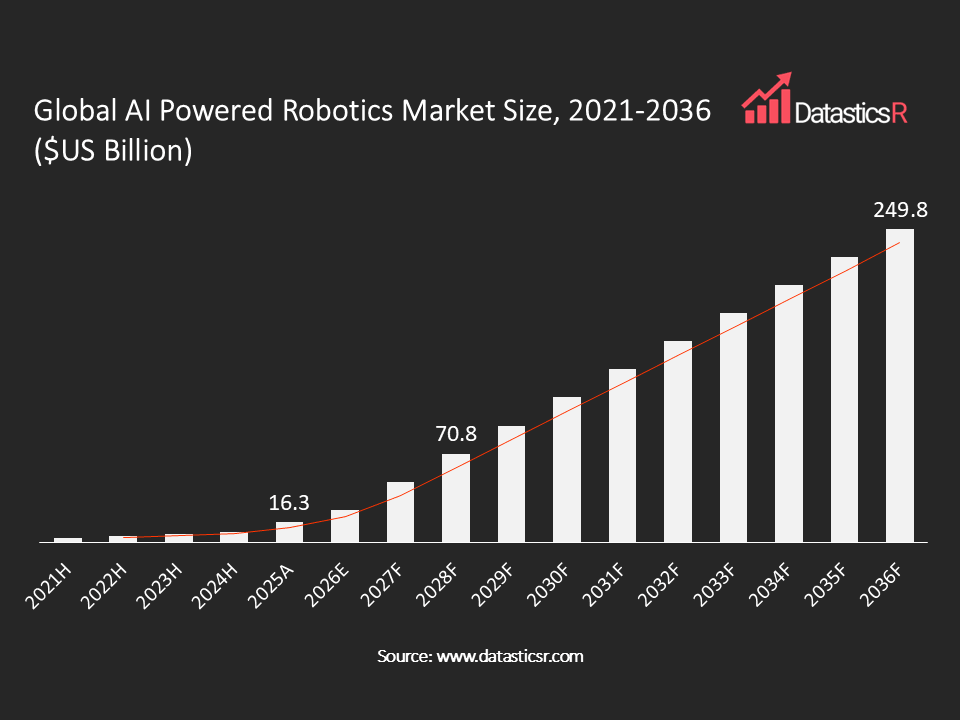
Market Snappshot
- Market Size in 2025: $US 16.3 Bn
- Forecast Market by 2036: $US 249.81 Bn
- CAGR for the Period 2026-2036: 25.3%
- Top Region in Terms of Market Share: North America (31.5%)
- Key Players: FANUC Corporation, ABB Ltd, Yaskawa Electric Corporation, KUKA SE & Co. KGaA, NVIDIA Corporation, Kawasaki Heavy Industries, Mitsubishi Electric Corporation, and Others
Analyst Viewpoint:
AI-powered robotics is moving past its early proof-of-concept phase and into a genuine software arms race. For years, the story in industrial robotics was about mechanical capability i.e. payload, speed, precision. That’s no longer where the real competition sits. The robots themselves are converging on similar hardware specs, while the AI layered on top of them, perception, decision-making, and adaptability, is what’s actually separating winners from laggards. What’s coming next is a shift in how robots are sold and priced. As software becomes the differentiator, expect vendors to move away from one-time hardware sales toward subscription-based AI capability upgrades, where a robot bought today gets meaningfully smarter over its lifetime through software alone. That changes the buyer’s calculation entirely: purchasing a robot becomes less like buying a machine and more like buying a platform. The companies best positioned aren’t necessarily the ones with the best robots today, they’re the ones building the software and data infrastructure to keep improving robots already in the field.
AI Powered Robotics Market Overview:
The AI-powered robotics market covers robots equipped with artificial intelligence capabilities, including machine learning, computer vision, and natural language processing, that let them perceive their surroundings, make decisions, and adapt to changing conditions rather than simply repeating pre-programmed movements. This includes both industrial robots on factory floors and increasingly capable service robots used in logistics, healthcare, and other commercial settings.
By technology, machine learning and deep learning lead with around 33.5% share, as manufacturers increasingly use these models for predictive maintenance, adaptive motion planning, and autonomous decision-making rather than fixed programming. By robot type, articulated robots, the classic multi-jointed industrial arm, hold the largest share at around 53%, reflecting their continued dominance in welding, assembly, and material handling applications despite growing interest in newer robot formats. By end-use industry, automotive manufacturing leads with roughly 27% share, driven by the complexity of electric vehicle production and a heavy push toward highly automated, minimally staffed manufacturing lines.
Manufacturing challenges in this space center less on the robots’ mechanical design and more on integration complexity: connecting AI software to existing factory systems, managing data privacy and cybersecurity risks as robots collect more operational data, and training a workforce that can maintain increasingly software-driven equipment. The industry has evolved quickly, from robots that simply repeated fixed motions to systems now capable of adjusting in real time to irregular objects, changing environments, and even natural-language instructions, a shift accelerated by rapid advances in generative AI and large language models over the past two years.
By technology, machine learning and deep learning lead with around 33.5% share, as manufacturers increasingly use these models for predictive maintenance, adaptive motion planning, and autonomous decision-making rather than fixed programming. By robot type, articulated robots, the classic multi-jointed industrial arm, hold the largest share at around 53%, reflecting their continued dominance in welding, assembly, and material handling applications despite growing interest in newer robot formats. By end-use industry, automotive manufacturing leads with roughly 27% share, driven by the complexity of electric vehicle production and a heavy push toward highly automated, minimally staffed manufacturing lines.
Manufacturing challenges in this space center less on the robots’ mechanical design and more on integration complexity: connecting AI software to existing factory systems, managing data privacy and cybersecurity risks as robots collect more operational data, and training a workforce that can maintain increasingly software-driven equipment. The industry has evolved quickly, from robots that simply repeated fixed motions to systems now capable of adjusting in real time to irregular objects, changing environments, and even natural-language instructions, a shift accelerated by rapid advances in generative AI and large language models over the past two years.
| Drivers | Persistent Labor Shortages are Accelerating Adoption of AI-Driven Automation |
| Rapid Advances in Machine Learning Software are Redefining Robot Capability |
Persistent Labor Shortages are Accelerating Adoption of AI-Driven Automation
Labor shortages have become one of the clearest, most consistently cited reasons manufacturers are investing in AI-powered robots. Global labor shortages across manufacturing and related sectors now exceed 50 million workers, according to industry estimates cited by NVIDIA in its own robotics platform announcements, a gap that’s pushing companies toward automation not as a cost-cutting measure but as an operational necessity. Without enough workers to fill factory floor and warehouse positions, AI-capable robots that can adapt to varied tasks are increasingly the only practical way to keep production running at scale.
Real order data backs up how quickly this is translating into purchases. The Association for Advancing Automation, the industry’s leading trade group, reported that North American robot orders rose 4.3% and revenue rose 7.5% in the first half of 2025 compared to the same period a year earlier, with collaborative robots accounting for a growing share of that demand 3,085 cobot units ordered in the first half of 2025 alone, valued at $114 million. This isn’t a projection; it’s actual purchasing activity, and it points to a market where labor-shortage-driven automation demand is already showing up in vendor order books, not just industry forecasts.
Germany illustrates where this trend leads at full maturity. Robot density in leading German automotive assembly plants has reached 1,500 units per 10,000 employees, the highest of any country in the world, reflecting decades of sustained automation investment driven by persistently tight labor markets and high labor costs. As similar labor pressures build in other major manufacturing economies, including the US and China, this level of automation density looks less like an outlier and more like a preview of where other regions are headed.
Real order data backs up how quickly this is translating into purchases. The Association for Advancing Automation, the industry’s leading trade group, reported that North American robot orders rose 4.3% and revenue rose 7.5% in the first half of 2025 compared to the same period a year earlier, with collaborative robots accounting for a growing share of that demand 3,085 cobot units ordered in the first half of 2025 alone, valued at $114 million. This isn’t a projection; it’s actual purchasing activity, and it points to a market where labor-shortage-driven automation demand is already showing up in vendor order books, not just industry forecasts.
Germany illustrates where this trend leads at full maturity. Robot density in leading German automotive assembly plants has reached 1,500 units per 10,000 employees, the highest of any country in the world, reflecting decades of sustained automation investment driven by persistently tight labor markets and high labor costs. As similar labor pressures build in other major manufacturing economies, including the US and China, this level of automation density looks less like an outlier and more like a preview of where other regions are headed.
Rapid Advances in Machine Learning Software are Redefining Robot Capability
The second major driver is a shift in where the real value in robotics is being created. The software segment of the AI robotics market is projected to grow at over 33% CAGR through the early 2030s, according to industry analysis, notably faster than hardware, as enterprises increasingly prioritize scalable AI capabilities like perception and real-time decision-making over purely mechanical automation improvements. That’s a meaningful shift from a decade ago, when a robot’s value was defined almost entirely by its physical specifications.
Investment activity reflects how seriously the industry is taking this shift. Funding for AI robotics startups reached approximately $30 billion in a single recent year, according to market estimates, as major technology companies and venture investors race to build the AI brains that will power the next generation of robots rather than just the robots themselves. NVIDIA, Amazon, Microsoft, and Alphabet are among the major technology companies now investing heavily in robotics-focused AI platforms, treating robot intelligence as a strategic platform play rather than a hardware side business.
This is changing how robot manufacturers compete. Rather than differentiating purely on payload capacity or arm speed, vendors are increasingly racing to offer better perception systems, faster decision-making software, and easier integration with existing factory data systems, since these are the capabilities that determine how well a robot actually performs in a real, messy production environment rather than a controlled demo.
Investment activity reflects how seriously the industry is taking this shift. Funding for AI robotics startups reached approximately $30 billion in a single recent year, according to market estimates, as major technology companies and venture investors race to build the AI brains that will power the next generation of robots rather than just the robots themselves. NVIDIA, Amazon, Microsoft, and Alphabet are among the major technology companies now investing heavily in robotics-focused AI platforms, treating robot intelligence as a strategic platform play rather than a hardware side business.
This is changing how robot manufacturers compete. Rather than differentiating purely on payload capacity or arm speed, vendors are increasingly racing to offer better perception systems, faster decision-making software, and easier integration with existing factory data systems, since these are the capabilities that determine how well a robot actually performs in a real, messy production environment rather than a controlled demo.
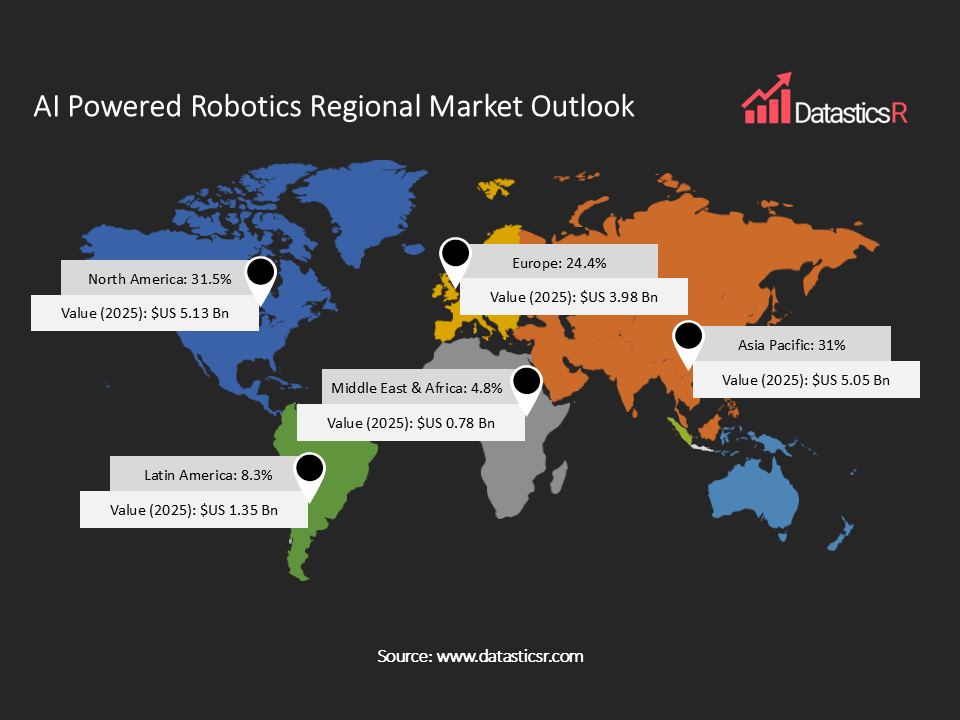
AI Powered Robotics Regional Market Outlook:
North America is at the forefront of the AI-driven robotic market segment with an estimated market share of 31.5% in 2025 due to the matured manufacturing environment, labor cost advantages which enhance automation’s ROI, and the need to bring production back home to cut off dependencies of the supply chain; the US alone makes up 84% of North America’s market share.
Asia Pacific follows closely at an estimated 31% share, driven by massive investment in electronics assembly and China’s “Made in China 2025” initiative, with China itself the largest single national market in the region, and India growing quickly as a rising adopter.
Europe holds about 24.4% market share with Germany, thanks to its engineering-intensive manufacturing industry, taking the lead and other European countries having a regional emphasis on Industry 4.0 standards and collaborative robots.
Latin America makes up an estimated market share of 8.3%. Among Latin American countries, Brazil takes the lead while Mexico follows. Middle East and Africa make up the smallest market share of the AI-driven robot market at 4.8%. It is still a developing market segment.
Asia Pacific follows closely at an estimated 31% share, driven by massive investment in electronics assembly and China’s “Made in China 2025” initiative, with China itself the largest single national market in the region, and India growing quickly as a rising adopter.
Europe holds about 24.4% market share with Germany, thanks to its engineering-intensive manufacturing industry, taking the lead and other European countries having a regional emphasis on Industry 4.0 standards and collaborative robots.
Latin America makes up an estimated market share of 8.3%. Among Latin American countries, Brazil takes the lead while Mexico follows. Middle East and Africa make up the smallest market share of the AI-driven robot market at 4.8%. It is still a developing market segment.
Key Companies in AI Powered Robotics Market:
The market has moderate concentration at the top end. The competition is as much about software capability as hardware, with large companies spending heavily on AI-enabled vision systems, cloud-based robotic platforms, and low code programming interfaces to create differentiation from mechanical capability. The latest developments have included the launch of new AI-enabled products, alliances between companies in key technologies, and building software platforms that enable robots to be deployed and upgraded constantly post-deployment.
Key players include FANUC Corporation, ABB Ltd, Yaskawa Electric Corporation, KUKA SE & Co. KGaA, Teradyne Inc., Kawasaki Heavy Industries, Mitsubishi Electric Corporation, Comau S.p.A., Universal Robots, Rockwell Automation, NVIDIA Corporation, Siemens AG, Epson Robots, Denso Corporation, Intuitive Surgical, Symbotic, Stryker, Boston Dynamics and Others.
Key players include FANUC Corporation, ABB Ltd, Yaskawa Electric Corporation, KUKA SE & Co. KGaA, Teradyne Inc., Kawasaki Heavy Industries, Mitsubishi Electric Corporation, Comau S.p.A., Universal Robots, Rockwell Automation, NVIDIA Corporation, Siemens AG, Epson Robots, Denso Corporation, Intuitive Surgical, Symbotic, Stryker, Boston Dynamics and Others.
Key Developments in AI Powered Robotics Market:
| 1. KUKA Launches iiQKA Cloud-Connected AI Operating System: In April 2025, KUKA launches. iiQKA.OS2 operating system includes a complete virtual robot controller (VRC). AI-capable, ready for the new ISO 10218:2025 and cyber-resilient, it makes digital manufacturing future-proof. |
| 2. ABB Adds AI-Powered Modules to Transform Fashion and Logistics Industries: In March 2025, ABB is expanding its portfolio of robotic solutions for logistics and e-commerce supply chains with the addition of two new AI-powered functional modules to its Item Picking family. |
AI Powered Robotics Market Attributes:
| ATTRIBUTE | DETAILS |
| Market Value, 2025 | $US 16.3 Billion |
| Forecasted Market Value, 2036 | $US 249.81 Billion |
| CAGR (2026-2036) | 25.3% |
| Analysis Period | 2021-2036 |
| Historic Period | 2021-2024 |
| Base Year | 2025 |
| Forecast Period | 2026-2036 |
| Volume Unit | NA |
| Value Unit | $US Billion |
| Market Segmentation | By Technology
By Robot Type
By Application
By End-use Industry
By Region
|
| Companies Profiles |
|
| Customization Request | Available upon request |
1. Introduction
1.1. Report Scope
1.2. Market Segmentations and Definitions
1.3. Geographical Coverage
2. Executive Summary
2.1. Key Facts and Figures
2.2. Trends Impacting the Market
2.3. DatasticsR Growth Opportunity Matrix
3. Market Overview
3.1. Global AI Powered Robotics Market Analysis and Forecast, 2021-2036
3.1.1. Global AI Powered Robotics Market Size ($US Bn)
3.2. Supply-side and Demand-side Trends
3.3. Technology Roadmap and Developments
3.4. Market Dynamics
3.4.1. Drivers
3.4.2. Restraints
3.4.3. Opportunities
3.5. Porter’s Five Forces Analysis
3.6. PESTL Analysis
3.7. Industry SWOT Analysis
3.8. Regulatory Landscape
3.9. Value Chain Analysis
3.9.1. List of Hardware Providers
3.9.2. List of Software Providers
3.9.3. List of Robotics Companies
3.9.4. List of Service Providers
3.9.5. List of Potential Customers
3.10. Impact of Current Geopolitical Scenario on the Market
4. Technical Analysis
4.1. Technical Specification Analysis
4.2. Details of Integration Process
4.3. Technology Adoption and Emerging Technologies
4.4. R&D Trends and Patents Landscape
4.5. Cost Structure and Profitability Analysis
5. Global AI Powered Robotics Investments ($US Billion), by Region, 2021-2025
5.1. North America
5.2. Europe
5.3. Asia Pacific
5.4. Latin America
5.5. Middle East and Africa
6. Global AI Powered Robotics Market Analysis and Forecasting ($US Bn), by Technology, 2021-2036
7. Global AI Powered Robotics Market Analysis and Forecasting ($US Bn), by Robot Type, 2021-2036
8. Global AI Powered Robotics Market Analysis and Forecasting ($US Bn), by Application, 2021-2036
9. Global AI Powered Robotics Market Analysis and Forecasting ($US Bn), by End-use Industry, 2021-2036
10. Global AI Powered Robotics Market Analysis and Forecasting ($US Bn), by Region, 2021-2036
11. North America AI Powered Robotics Market Analysis and Forecasting ($US Bn), by Technology, 2021-2036
12. North America AI Powered Robotics Market Analysis and Forecasting ($US Bn), by Robot Type, 2021-2036
13. North America AI Powered Robotics Market Analysis and Forecasting ($US Bn), by Application, 2021-2036
14. North America AI Powered Robotics Market Analysis and Forecasting ($US Bn), by End-use Industry, 2021-2036
15. U.S. AI Powered Robotics Market Analysis and Forecasting ($US Bn), by Technology, 2021-2036
16. U.S. AI Powered Robotics Market Analysis and Forecasting ($US Bn), by Robot Type, 2021-2036
17. U.S. AI Powered Robotics Market Analysis and Forecasting ($US Bn), by Application, 2021-2036
18. U.S. AI Powered Robotics Market Analysis and Forecasting ($US Bn), by End-use Industry, 2021-2036
19. Canada AI Powered Robotics Market Analysis and Forecasting ($US Bn), by Technology, 2021-2036
20. Canada AI Powered Robotics Market Analysis and Forecasting ($US Bn), by Robot Type, 2021-2036
21. Canada AI Powered Robotics Market Analysis and Forecasting ($US Bn), by Application, 2021-2036
22. Canada AI Powered Robotics Market Analysis and Forecasting ($US Bn), by End-use Industry, 2021-2036
23. Europe AI Powered Robotics Market Analysis and Forecasting ($US Bn), by Technology, 2021-2036
24. Europe AI Powered Robotics Market Analysis and Forecasting ($US Bn), by Robot Type, 2021-2036
25. Europe AI Powered Robotics Market Analysis and Forecasting ($US Bn), by Application, 2021-2036
26. Europe AI Powered Robotics Market Analysis and Forecasting ($US Bn), by End-use Industry, 2021-2036
27. Germany AI Powered Robotics Market Analysis and Forecasting ($US Bn), by Technology, 2021-2036
28. Germany AI Powered Robotics Market Analysis and Forecasting ($US Bn), by Robot Type, 2021-2036
29. Germany AI Powered Robotics Market Analysis and Forecasting ($US Bn), by Application, 2021-2036
30. Germany AI Powered Robotics Market Analysis and Forecasting ($US Bn), by End-use Industry, 2021-2036
31. U.K. AI Powered Robotics Market Analysis and Forecasting ($US Bn), by Technology, 2021-2036
32. U.K. AI Powered Robotics Market Analysis and Forecasting ($US Bn), by Robot Type, 2021-2036
33. U.K. AI Powered Robotics Market Analysis and Forecasting ($US Bn), by Application, 2021-2036
34. U.K. AI Powered Robotics Market Analysis and Forecasting ($US Bn), by End-use Industry, 2021-2036
35. France AI Powered Robotics Market Analysis and Forecasting ($US Bn), by Technology, 2021-2036
36. France AI Powered Robotics Market Analysis and Forecasting ($US Bn), by Robot Type, 2021-2036
37. France AI Powered Robotics Market Analysis and Forecasting ($US Bn), by Application, 2021-2036
38. France AI Powered Robotics Market Analysis and Forecasting ($US Bn), by End-use Industry, 2021-2036
39. Italy AI Powered Robotics Market Analysis and Forecasting ($US Bn), by Technology, 2021-2036
40. Italy AI Powered Robotics Market Analysis and Forecasting ($US Bn), by Robot Type, 2021-2036
41. Italy AI Powered Robotics Market Analysis and Forecasting ($US Bn), by Application, 2021-2036
42. Italy AI Powered Robotics Market Analysis and Forecasting ($US Bn), by End-use Industry, 2021-2036
43. Spain AI Powered Robotics Market Analysis and Forecasting ($US Bn), by Technology, 2021-2036
44. Spain AI Powered Robotics Market Analysis and Forecasting ($US Bn), by Robot Type, 2021-2036
45. Spain AI Powered Robotics Market Analysis and Forecasting ($US Bn), by Application, 2021-2036
46. Spain AI Powered Robotics Market Analysis and Forecasting ($US Bn), by End-use Industry, 2021-2036
47. Russia & CIS AI Powered Robotics Market Analysis and Forecasting ($US Bn), by Technology, 2021-2036
48. Russia & CIS AI Powered Robotics Market Analysis and Forecasting ($US Bn), by Robot Type, 2021-2036
49. Russia & CIS AI Powered Robotics Market Analysis and Forecasting ($US Bn), by Application, 2021-2036
50. Russia & CIS AI Powered Robotics Market Analysis and Forecasting ($US Bn), by End-use Industry, 2021-2036
51. Rest of Europe AI Powered Robotics Market Analysis and Forecasting ($US Bn), by Technology, 2021-2036
52. Rest of Europe AI Powered Robotics Market Analysis and Forecasting ($US Bn), by Robot Type, 2021-2036
53. Rest of Europe AI Powered Robotics Market Analysis and Forecasting ($US Bn), by Application, 2021-2036
54. Rest of Europe AI Powered Robotics Market Analysis and Forecasting ($US Bn), by End-use Industry, 2021-2036
55. Asia Pacific AI Powered Robotics Market Analysis and Forecasting ($US Bn), by Technology, 2021-2036
56. Asia Pacific AI Powered Robotics Market Analysis and Forecasting ($US Bn), by Robot Type, 2021-2036
57. Asia Pacific AI Powered Robotics Market Analysis and Forecasting ($US Bn), by Application, 2021-2036
58. Asia Pacific AI Powered Robotics Market Analysis and Forecasting ($US Bn), by End-use Industry, 2021-2036
59. China AI Powered Robotics Market Analysis and Forecasting ($US Bn), by Technology, 2021-2036
60. China AI Powered Robotics Market Analysis and Forecasting ($US Bn), by Robot Type, 2021-2036
61. China AI Powered Robotics Market Analysis and Forecasting ($US Bn), by Application, 2021-2036
62. China AI Powered Robotics Market Analysis and Forecasting ($US Bn), by End-use Industry, 2021-2036
63. India AI Powered Robotics Market Analysis and Forecasting ($US Bn), by Technology, 2021-2036
64. India AI Powered Robotics Market Analysis and Forecasting ($US Bn), by Robot Type, 2021-2036
65. India AI Powered Robotics Market Analysis and Forecasting ($US Bn), by Application, 2021-2036
66. India AI Powered Robotics Market Analysis and Forecasting ($US Bn), by End-use Industry, 2021-2036
67. Japan AI Powered Robotics Market Analysis and Forecasting ($US Bn), by Technology, 2021-2036
68. Japan AI Powered Robotics Market Analysis and Forecasting ($US Bn), by Robot Type, 2021-2036
69. Japan AI Powered Robotics Market Analysis and Forecasting ($US Bn), by Application, 2021-2036
70. Japan AI Powered Robotics Market Analysis and Forecasting ($US Bn), by End-use Industry, 2021-2036
71. South Korea AI Powered Robotics Market Analysis and Forecasting ($US Bn), by Technology, 2021-2036
72. South Korea AI Powered Robotics Market Analysis and Forecasting ($US Bn), by Robot Type, 2021-2036
73. South Korea AI Powered Robotics Market Analysis and Forecasting ($US Bn), by Application, 2021-2036
74. South Korea AI Powered Robotics Market Analysis and Forecasting ($US Bn), by End-use Industry, 2021-2036
75. Taiwan AI Powered Robotics Market Analysis and Forecasting ($US Bn), by Technology, 2021-2036
76. Taiwan AI Powered Robotics Market Analysis and Forecasting ($US Bn), by Robot Type, 2021-2036
77. Taiwan AI Powered Robotics Market Analysis and Forecasting ($US Bn), by Application, 2021-2036
78. Taiwan AI Powered Robotics Market Analysis and Forecasting ($US Bn), by End-use Industry, 2021-2036
79. Australia AI Powered Robotics Market Analysis and Forecasting ($US Bn), by Technology, 2021-2036
80. Australia AI Powered Robotics Market Analysis and Forecasting ($US Bn), by Robot Type, 2021-2036
81. Australia AI Powered Robotics Market Analysis and Forecasting ($US Bn), by Application, 2021-2036
82. Australia AI Powered Robotics Market Analysis and Forecasting ($US Bn), by End-use Industry, 2021-2036
83. ASEAN AI Powered Robotics Market Analysis and Forecasting ($US Bn), by Technology, 2021-2036
84. ASEAN AI Powered Robotics Market Analysis and Forecasting ($US Bn), by Robot Type, 2021-2036
85. ASEAN AI Powered Robotics Market Analysis and Forecasting ($US Bn), by Application, 2021-2036
86. ASEAN AI Powered Robotics Market Analysis and Forecasting ($US Bn), by End-use Industry, 2021-2036
87. Rest of Asia Pacific AI Powered Robotics Market Analysis and Forecasting ($US Bn), by Technology, 2021-2036
88. Rest of Asia Pacific AI Powered Robotics Market Analysis and Forecasting ($US Bn), by Robot Type, 2021-2036
89. Rest of Asia Pacific AI Powered Robotics Market Analysis and Forecasting ($US Bn), by Application, 2021-2036
90. Rest of Asia Pacific AI Powered Robotics Market Analysis and Forecasting ($US Bn), by End-use Industry, 2021-2036
91. Latin America AI Powered Robotics Market Analysis and Forecasting ($US Bn), by Technology, 2021-2036
92. Latin America AI Powered Robotics Market Analysis and Forecasting ($US Bn), by Robot Type, 2021-2036
93. Latin America AI Powered Robotics Market Analysis and Forecasting ($US Bn), by Application, 2021-2036
94. Latin America AI Powered Robotics Market Analysis and Forecasting ($US Bn), by End-use Industry, 2021-2036
95. Brazil AI Powered Robotics Market Analysis and Forecasting ($US Bn), by Technology, 2021-2036
96. Brazil AI Powered Robotics Market Analysis and Forecasting ($US Bn), by Robot Type, 2021-2036
97. Brazil AI Powered Robotics Market Analysis and Forecasting ($US Bn), by Application, 2021-2036
98. Brazil AI Powered Robotics Market Analysis and Forecasting ($US Bn), by End-use Industry, 2021-2036
99. Mexico AI Powered Robotics Market Analysis and Forecasting ($US Bn), by Technology, 2021-2036
100. Mexico AI Powered Robotics Market Analysis and Forecasting ($US Bn), by Robot Type, 2021-2036
101. Mexico AI Powered Robotics Market Analysis and Forecasting ($US Bn), by Application, 2021-2036
102. Mexico AI Powered Robotics Market Analysis and Forecasting ($US Bn), by End-use Industry, 2021-2036
103. Argentina AI Powered Robotics Market Analysis and Forecasting ($US Bn), by Technology, 2021-2036
104. Argentina AI Powered Robotics Market Analysis and Forecasting ($US Bn), by Robot Type, 2021-2036
105. Argentina AI Powered Robotics Market Analysis and Forecasting ($US Bn), by Application, 2021-2036
106. Argentina AI Powered Robotics Market Analysis and Forecasting ($US Bn), by End-use Industry, 2021-2036
107. Rest of Latin America AI Powered Robotics Market Analysis and Forecasting ($US Bn), by Technology, 2021-2036
108. Rest of Latin America AI Powered Robotics Market Analysis and Forecasting ($US Bn), by Robot Type, 2021-2036
109. Rest of Latin America AI Powered Robotics Market Analysis and Forecasting ($US Bn), by Application, 2021-2036
110. Rest of Latin America AI Powered Robotics Market Analysis and Forecasting ($US Bn), by End-use Industry, 2021-2036
111. Middle East & Africa AI Powered Robotics Market Analysis and Forecasting ($US Bn), by Technology, 2021-2036
112. Middle East & Africa AI Powered Robotics Market Analysis and Forecasting ($US Bn), by Robot Type, 2021-2036
113. Middle East & Africa AI Powered Robotics Market Analysis and Forecasting ($US Bn), by Application, 2021-2036
114. Middle East & Africa AI Powered Robotics Market Analysis and Forecasting ($US Bn), by End-use Industry, 2021-2036
115. Saudi Arabia AI Powered Robotics Market Analysis and Forecasting ($US Bn), by Technology, 2021-2036
116. Saudi Arabia AI Powered Robotics Market Analysis and Forecasting ($US Bn), by Robot Type, 2021-2036
117. Saudi Arabia AI Powered Robotics Market Analysis and Forecasting ($US Bn), by Application, 2021-2036
118. Saudi Arabia AI Powered Robotics Market Analysis and Forecasting ($US Bn), by End-use Industry, 2021-2036
119. UAE AI Powered Robotics Market Analysis and Forecasting ($US Bn), by Technology, 2021-2036
120. UAE AI Powered Robotics Market Analysis and Forecasting ($US Bn), by Robot Type, 2021-2036
121. UAE AI Powered Robotics Market Analysis and Forecasting ($US Bn), by Application, 2021-2036
122. UAE AI Powered Robotics Market Analysis and Forecasting ($US Bn), by End-use Industry, 2021-2036
123. South Africa AI Powered Robotics Market Analysis and Forecasting ($US Bn), by Technology, 2021-2036
124. South Africa AI Powered Robotics Market Analysis and Forecasting ($US Bn), by Robot Type, 2021-2036
125. South Africa AI Powered Robotics Market Analysis and Forecasting ($US Bn), by Application, 2021-2036
126. South Africa AI Powered Robotics Market Analysis and Forecasting ($US Bn), by End-use Industry, 2021-2036
127. Rest of Middle East & Africa AI Powered Robotics Market Analysis and Forecasting ($US Bn), by Technology, 2021-2036
128. Rest of Middle East & Africa AI Powered Robotics Market Analysis and Forecasting ($US Bn), by Robot Type, 2021-2036
129. Rest of Middle East & Africa AI Powered Robotics Market Analysis and Forecasting ($US Bn), by Application, 2021-2036
130. Rest of Middle East & Africa AI Powered Robotics Market Analysis and Forecasting ($US Bn), by End-use Industry, 2021-2036
131. Competition Landscape
131.1. Market Share Analysis (%), by Company, 2025
131.2. Competitive Benchmarking
131.3. Company Profiles
131.3.1. FANUC Corporation
131.3.1.1. Company Overview
131.3.1.2. Business Portfolio
131.3.1.3. Financials
131.3.1.4. Geographical Footprint
131.3.1.5. SWOT Analysis
131.3.1.6. Recent Developments and Strategies
131.3.2. ABB Ltd
131.3.2.1. Company Overview
131.3.2.2. Business Portfolio
131.3.2.3. Financials
131.3.2.4. Geographical Footprint
131.3.2.5. SWOT Analysis
131.3.2.6. Recent Developments and Strategies
131.3.3. Yaskawa Electric Corporation
131.3.3.1. Company Overview
131.3.3.2. Business Portfolio
131.3.3.3. Financials
131.3.3.4. Geographical Footprint
131.3.3.5. SWOT Analysis
131.3.3.6. Recent Developments and Strategies
131.3.4. KUKA SE & Co. KGaA
131.3.4.1. Company Overview
131.3.4.2. Business Portfolio
131.3.4.3. Financials
131.3.4.4. Geographical Footprint
131.3.4.5. SWOT Analysis
131.3.4.6. Recent Developments and Strategies
131.3.5. Teradyne Inc.
131.3.5.1. Company Overview
131.3.5.2. Business Portfolio
131.3.5.3. Financials
131.3.5.4. Geographical Footprint
131.3.5.5. SWOT Analysis
131.3.5.6. Recent Developments and Strategies
131.3.6. Kawasaki Heavy Industries
131.3.6.1. Company Overview
131.3.6.2. Business Portfolio
131.3.6.3. Financials
131.3.6.4. Geographical Footprint
131.3.6.5. SWOT Analysis
131.3.6.6. Recent Developments and Strategies
131.3.7. Mitsubishi Electric Corporation
131.3.7.1. Company Overview
131.3.7.2. Business Portfolio
131.3.7.3. Financials
131.3.7.4. Geographical Footprint
131.3.7.5. SWOT Analysis
131.3.7.6. Recent Developments and Strategies
131.3.8. Comau S.p.A.
131.3.8.1. Company Overview
131.3.8.2. Business Portfolio
131.3.8.3. Financials
131.3.8.4. Geographical Footprint
131.3.8.5. SWOT Analysis
131.3.8.6. Recent Developments and Strategies
131.3.9. Universal Robots
131.3.9.1. Company Overview
131.3.9.2. Business Portfolio
131.3.9.3. Financials
131.3.9.4. Geographical Footprint
131.3.9.5. SWOT Analysis
131.3.9.6. Recent Developments and Strategies
131.3.10. Rockwell Automation
131.3.10.1. Company Overview
131.3.10.2. Business Portfolio
131.3.10.3. Financials
131.3.10.4. Geographical Footprint
131.3.10.5. SWOT Analysis
131.3.10.6. Recent Developments and Strategies
131.3.11. NVIDIA Corporation
131.3.11.1. Company Overview
131.3.11.2. Business Portfolio
131.3.11.3. Financials
131.3.11.4. Geographical Footprint
131.3.11.5. SWOT Analysis
131.3.11.6. Recent Developments and Strategies
131.3.12. Siemens AG
131.3.12.1. Company Overview
131.3.12.2. Business Portfolio
131.3.12.3. Financials
131.3.12.4. Geographical Footprint
131.3.12.5. SWOT Analysis
131.3.12.6. Recent Developments and Strategies
131.3.13. Epson Robots
131.3.13.1. Company Overview
131.3.13.2. Business Portfolio
131.3.13.3. Financials
131.3.13.4. Geographical Footprint
131.3.13.5. SWOT Analysis
131.3.13.6. Recent Developments and Strategies
131.3.14. Denso Corporation
131.3.14.1. Company Overview
131.3.14.2. Business Portfolio
131.3.14.3. Financials
131.3.14.4. Geographical Footprint
131.3.14.5. SWOT Analysis
131.3.14.6. Recent Developments and Strategies
131.3.15. Intuitive Surgical
131.3.15.1. Company Overview
131.3.15.2. Business Portfolio
131.3.15.3. Financials
131.3.15.4. Geographical Footprint
131.3.15.5. SWOT Analysis
131.3.15.6. Recent Developments and Strategies
131.3.16. Symbotic
131.3.16.1. Company Overview
131.3.16.2. Business Portfolio
131.3.16.3. Financials
131.3.16.4. Geographical Footprint
131.3.16.5. SWOT Analysis
131.3.16.6. Recent Developments and Strategies
131.3.17. Stryker
131.3.17.1. Company Overview
131.3.17.2. Business Portfolio
131.3.17.3. Financials
131.3.17.4. Geographical Footprint
131.3.17.5. SWOT Analysis
131.3.17.6. Recent Developments and Strategies
131.3.18. Boston Dynamics
131.3.18.1. Company Overview
131.3.18.2. Business Portfolio
131.3.18.3. Financials
131.3.18.4. Geographical Footprint
131.3.18.5. SWOT Analysis
131.3.18.6. Recent Developments and Strategies
131.3.19. Others
132. Appendix

- Get Started -
Get insights that lead to new growth opportunities
- Talk to Experts -
Get answers to your queries on this report from our experts
Frequently Asked Questions
The global AI Powered Robotics market in 2025 was $US 16.3 Billion.
The global AI Powered Robotics market will be $US 249.81 Billion by 2036.
The expected growth rate (CAGR%) of the global AI Powered Robotics market is 25.3% for the period 2026-2036.
Persistent Labor Shortages are Accelerating Adoption of AI-Driven Automation and Rapid Advances in Machine Learning Software are Redefining Robot Capability.
Machine Learning & Deep Learning was the largest segment in technology holding around 33.5% share among all in AI Powered Robotics Market in 2025.
North America was the leading regions for AI Powered Robotics holding 31.5% of the global market in 2025.
FANUC Corporation, ABB Ltd, Yaskawa Electric Corporation, KUKA SE & Co. KGaA, Teradyne Inc., Kawasaki Heavy Industries, Mitsubishi Electric Corporation, Comau S.p.A., Universal Robots, Rockwell Automation, NVIDIA Corporation, Siemens AG, Epson Robots, Denso Corporation, Intuitive Surgical, Symbotic, Stryker, Boston Dynamics and Others.